
Top 12 Benefits of CRM Systems for Sales, Marketing & Growth

A Customer Relationship Management (CRM) centralizes data, improves visibility, and automates key processes across sales and marketing.
Why is CRM so important?
Without structured systems in place, it’s much harder to monitor opportunities, measure performance, and have visibility across departments.
Read on to learn more about all the key benefits of CRM systems and the ways these systems can help you scale efficiently.
Key Takeaways:
- Centralized lead data improves sales efficiency
Storing all contacts, interactions, and notes in one system prevents lost leads, speeds up responses, and ensures the team has full visibility into lead history. - Clear pipeline visibility enables better forecasting
A visual, structured sales pipeline helps track deals, spot bottlenecks, and estimate revenue with confidence. Teams can identify patterns, proactively adjust strategies, and reduce planning uncertainty. - Automation boosts consistency and productivity
CRM automation handles reminders, follow-ups, and repetitive tasks so teams can focus on building relationships rather than manual data entry. Automated workflows increase conversion rates. - Marketing becomes measurable and targeted
CRM systems track lead journeys, campaign performance, and engagement, allowing marketing to deliver personalized messages and allocate budget effectively. - Sustainable growth requires scalable, AI-powered tools
CRM supports expansion, retention, and predictable revenue by standardizing processes and connecting teams. Knowlix AI takes it further by combining AI-powered note-taking, automation, and integrated apps to turn conversations and data into actionable insights, helping small businesses scale efficiently
12 benefits of CRM systems for sales, marketing, and growth you should know about
CRM systems strengthen sales execution, sharpen marketing strategy, and build the foundation needed for sustainable expansion.
Discover below the key CRM benefits across sales, marketing, and growth.
The benefits of CRM for sales teams
Here are the key benefits that directly impact sales performance and revenue consistency.
1. Centralized lead and contact management
Lead information is often scattered in spreadsheets, inboxes, notebooks, or databases.
Consequently, this creates slow response times and increases the risk of losing valuable leads.
A CRM system eliminates this by acting as a single, centralized source of truth for all lead and lead data.
With CRM, every interaction, such as emails, calls, meetings, notes, proposals, and previous purchases, is stored in a unified system.
This way, sales teams can instantly see a contact’s full history without switching between tools or asking colleagues for updates.
On top of this, it shows the team which leads not to contact because they’ve said no, and which ones to follow up on after an important conversation.
Centralized data also strengthens team collaboration.
If a team member is absent or leaves the company, their knowledge stays right where it belongs, with the entire sales history remaining accessible and organized.
2. Clear sales pipeline visibility
Without a structured sales pipeline, it’s difficult to know:
- How many deals are active
- Which ones are close to closing
- Where issues exist
A CRM system provides a clear, visual representation of your entire sales pipeline.
With defined deal stages, such as new lead, qualified, proposal sent, negotiation, and closed deal, you can track every opportunity from start to finish.
Sales teams can immediately see how many deals are in each stage and identify patterns.
Are too many deals getting stuck at the proposal stage? Is follow-up happening quickly enough?
All these insights enable proactive adjustments.
Pipeline visibility improves forecasting accuracy and cash flow management because you can estimate revenue based on real-time data.
3. Automated follow-ups and task reminders
With CRM, you can automate reminders and repetitive tasks.
For example, you can set reminders to follow up after meetings, send automated nurture emails, or assign tasks when a lead reaches a specific stage.
If a lead downloads a pricing guide, the CRM can notify the sales team to reach out within 24 hours.
If a proposal is sent, it can automatically trigger a reminder to check in after three days, for example.
Automation ensures no lead goes cold simply because someone forgot to respond. It helps you create consistency across the team and standardize best practices.
Besides reminders, automation can also help reduce administrative work.
Instead of manually updating spreadsheets or drafting repetitive emails, your automated CRM tool handles these processes in the background.
As a result, sales teams can focus on conversations and relationship-building instead of data entry.
Worth knowing
CRM platforms boost sales by tracking leads and automating follow-ups, which can increase conversion rates up to 300% and revenue by 29% on average.
Knowlix’s AI Teammate integrates into the existing sales workflow, supporting teams before, during, and after meetings without requiring manual coordination across different tools.
During a sales call or meeting, the AI Notetaker captures the conversation, identifies key points, and combines them with the team’s notes into a structured and organized record.
After the meeting, the system moves from documentation to follow-through. It automatically:
- Updates the deal stage in the pipeline
- Adds structured notes to the CRM record
- Creates relevant follow-up tasks
- Drafts a quotation for review
- Schedules the next steps discussed during the meeting
Instead of letting notes sit scattered, with Knowlix you can instantly turn conversations into pipeline progress.
4. Better lead qualification
Not every lead is ready to buy, and treating them all the same wastes time and energy that can be redirected otherwise.
With CRM, you can identify and prioritize high-quality leads.
CRM systems allow you to implement lead scoring based on specific criteria, such as:
- Website activity
- Email engagement
- Job role
- Company size
- Past interactions
For example, a lead who downloads multiple resources and visits your pricing page can be scored higher than someone who simply subscribed to your newsletter.
This scoring system helps you focus on what matters most and prioritize leads with strong buying signals.
CRMs can help with smarter lead distribution, too.
Based on territory, industry, or expertise, leads can automatically be assigned to the most appropriate sales team member.
Worth knowing:
Some CRM systems allow sales teams to interact directly with AI inside the platform to manage leads more efficiently.
You can prompt Knowlix’s AI Teammate directly to manage leads efficiently.
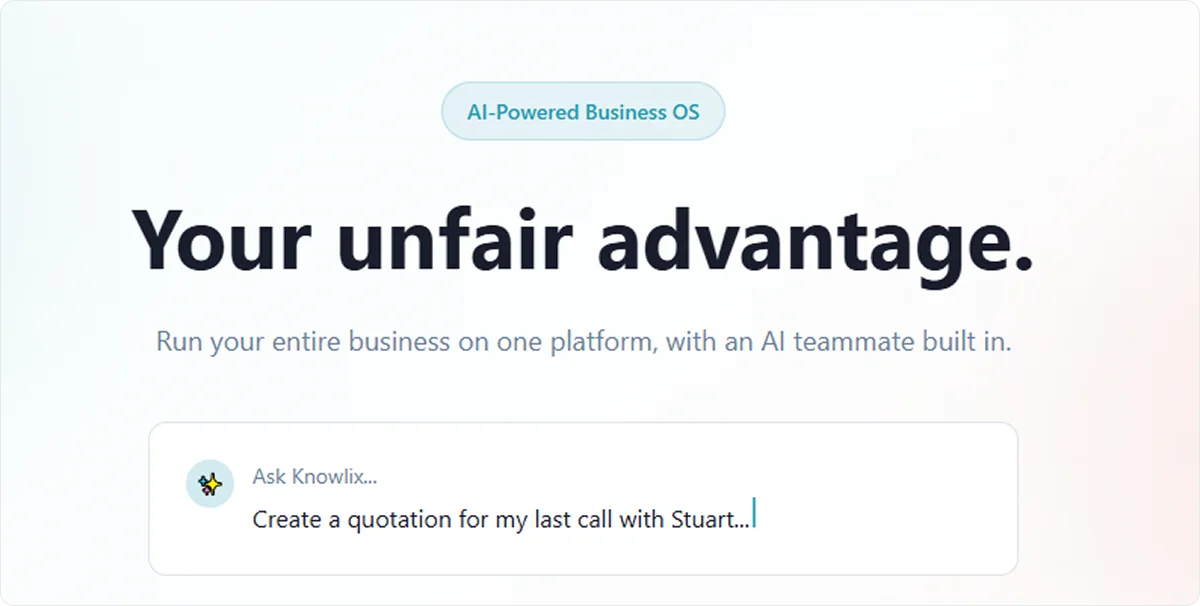
For example, you can type, “Create a new lead for Sarah Johnson from Acme Corp, interested in the Enterprise plan,” and the system will:
- Check for existing records
- Update details if needed
- Create a new lead in the correct pipeline stage
It can also work asynchronously, detect intent from incoming emails, and update or create leads.
In addition, it can move deals through the pipeline and automatically draft quotations.
The benefits of CRM for marketing teams
For marketing teams, a CRM system connects campaigns to actual sales outcomes. Here are the main benefits you should know about.
1. Complete lead journey tracking
A CRM connects every touchpoint to create a clear, end-to-end view of how leads engage with your brand.
When someone fills out a form, opens an email, clicks an ad, attends a webinar, or speaks with sales, those interactions are recorded in one system.
The unified tracking allows a marketing team to understand exactly how leads move from awareness to consideration, and from consideration to decision.
The greatest benefit is that you can see patterns in real data, so you can optimize each stage.
In addition, if you know what content a lead has already liked, you can tailor future messaging accordingly to increase engagement and improve overall lead experience.
2. Better campaign tracking and ROI measurement
A CRM system can connect campaigns directly to the pipeline and sales outcomes.
With integrated reporting, you can track:
- Which campaigns generate the most leads
- Which channels produce the highest conversion rates
- Which specific marketing efforts contribute to revenue
This way, you don’t measure vanity metrics, such as clicks or impressions alone, but you gain visibility into true ROI.
For example, you may discover that while social media generates high engagement, email campaigns drive more qualified leads.
Because of this insight, you can allocate the budget more strategically.
3. Marketing automation
Marketing automation within a CRM system allows you to scale communication without increasing workload.
Automation enables you to create email nurturing sequences that educate leads over time.
For example, when someone downloads a resource, they can automatically enter a tailored sequence that delivers relevant information step by step.
If they engage heavily, the system can notify sales. On the other hand, if they go quiet, re-engagement campaigns can trigger automatically.
Audience segmentation is another powerful aspect.
To avoid sending generic messages, you can group contacts based on behavior, interests, location, or stage in the buyer journey.
This results in increased personalization and better engagement rates while ensuring consistency.
Good to know: 71% of consumers expect personalization, and businesses that implement it can see a 10-15% revenue growth.
4. Improved sales and marketing alignment
With a CRM you can eliminate the misalignment that often exists between sales and marketing teams by creating a shared system.
Sales can see which campaigns a lead engaged with before reaching out, while marketing can see which prospects converted into leads and how much revenue they generated.
If you are a growing company, alignment accelerates growth by increasing conversion rates, shortening sales cycles, and enabling you to use resources more efficiently.
When both teams work from the same data, messaging becomes consistent, and the end-to-end lead experience improves.
The benefits of CRM for business growth
In addition to sales and marketing, CRM systems strengthen your business's foundation and directly support long-term, sustainable growth.
1. Data-driven decision making
Growth becomes far more predictable when data back decisions and CRM systems provide real-time dashboards and reports that turn raw information into actionable insights.
You can:
- Track conversion rates at every stage of the funnel
- Measure sales velocity
- Analyze lead acquisition costs
- Monitor revenue trends over time
Therefore, you can identify exactly where the slowdown occurred and reduce investment risk.
For example, before hiring additional staff or increasing marketing spend, you can objectively evaluate performance metrics.
When you understand what drives revenue and what doesn’t, you can systematically replicate efficient methods.
2. Improved lead retention
Did you know that repeat leads spend roughly 67% more on average than first-time buyers?
Also, the probability of selling to an existing lead is 60–70%, compared to just 5–20% for a new lead
It means that retaining existing leads is more cost-effective and profitable than acquiring new ones.
A CRM helps with lead retention by helping you maintain organized, personalized relationships long after the initial sale.
With access to purchase history, service interactions, and communication records, your team can anticipate needs and deliver timely follow-ups.
At the same time, you can automate renewal reminders, check-in emails, and personalized offers.
CRM data can identify upsell and cross-sell opportunities as well.
For example, if a lead frequently purchases a specific service, you can recommend complementary solutions at the right time.
Strong retention builds recurring revenue and increases lifetime lead value.
When you run a small business, strong lead relationships are often the biggest competitive advantage, and a robust CRM ensures you nurture those relationships consistently.
3. Scalable systems for expansion
When your business starts growing, the growth also starts exposing weaknesses in manual processes.
With CRM, you can get the infrastructure needed to support expansion.
You can add users, define roles, and standardize workflows to ensure consistency in sales conversations, follow-ups, and lead communication.
CRM systems also integrate with accounting software, lead support tools, and marketing platforms.
As a result, you can benefit from a connected ecosystem that removes data silos and improves efficiency across departments.
That’s why it’s important to have a scalable CRM that can grow with your business and help you refine your processes and not constantly rebuild them.
Worth knowing
Knowlix combines AI-powered note-taking with more than 50 integrated business tools and an AI Teammate within a single platform.
Instead of routing meeting data through external connectors, captured insights flow directly into connected modules such as the CRM, calendar, task management, and lead service systems.
This means meeting information is automatically converted into structured data that supports pipeline updates, follow-ups, and internal collaboration.
Because everything operates within a unified environment, teams don’t need to manually transfer information between tools, which reduces duplicate entries and ensures your team can focus on fewer manual tasks and more of the work that actually matters.
4. Predictable and sustainable revenue growth
With organized pipelines, accurate marketing attribution, retention tracking, and performance dashboards, you gain a comprehensive view of revenue drivers.
You can identify which activities consistently generate results and replicate them.
- Predictable revenue:
- Supports better budgeting, hiring, and strategic planning
- Reduces uncertainty
- Builds confidence in expansion decisions
Shorter sales cycles, improved conversion rates, higher lifetime value, and reduced churn all contribute to sustainable profitability.
Debunking 3 most common misconceptions about CRM systems
Despite the clear advantages of CRM systems, many businesses hesitate to adopt them because of outdated assumptions and misconceptions.
1. “CRMs are only for big companies.”
In the past, CRM platforms were complex, expensive enterprise systems catering primarily to large corporations.
However, CRM platforms now serve startups, small businesses, and growing teams.
Many providers offer scalable plans that let you start small, add features as you grow, and match them to your current needs.
Good to know: Smaller businesses often benefit more from CRM systems because they can’t afford inefficiency.
2. “CRMs are too expensive.”
It’s understandable that cost is one of the biggest concerns for small businesses. Nonetheless, CRM platforms usually offer free tiers or affordable entry-level plans tailored specifically for small teams.
Perhaps a more important question is how much disorganization is costing your business.
Missed follow-ups, lost leads, poor forecasting, and inefficient marketing campaigns can drain revenue.
Good to know: When you consider the value of one recovered deal or improved retention rate, a CRM often pays for itself quickly.
3. “ CRMs are too complicated.”
Another common misconception is that CRM systems are difficult to implement and require technical expertise.
While older systems were indeed complex, current platforms usually prioritize simplicity.
CRMs include:
- Intuitive dashboards
- Drag-and-drop pipelines
- Automation templates
- Guided onboarding.
Many can be set up in a matter of hours rather than months.
Additionally, most platforms offer tutorials, knowledge bases, and lead support to ensure smooth adoption.
Good to know: The key is to start simple and focus on core features before adding more advanced ones.
How can you reap the benefits of CRM with Knowlix?
Knowlix is an all-in-one business AI platform that unifies operations and reduces tool fragmentation.
Instead of separate systems for sales, marketing, project management, lead service, and invoicing, Knowlix combines over 50 integrated apps into a single platform, fully connected to your CRM and powered by your AI teammate
With everything in one system, data flows seamlessly across departments, keeping information up to date and eliminating manual transfers.
Despite its robust capabilities, Knowlix stays easy to use.
Teams can get started immediately without complex setup or heavy training, and activate or deactivate apps with a single click.
Most features come included in the base plan, letting you scale productivity without adding software costs.
By combining centralized operations, intelligent automation, and an intuitive interface, Knowlix helps small and growing businesses:
- Turn conversations and data into actionable insights
- Streamline processes
- Leverage the full potential of their CRM
Curious to see how our solution can work for your team?
Get to know Knowlix today to learn how to turn CRM data into actionable growth.
FAQ:
1. How does CRM boost sales performance?
A CRM boosts sales performance by organizing all lead data and interactions in one centralized system and giving sales teams full visibility into their pipeline.
It automates follow-ups, prioritizes high-quality leads, and reduces manual tasks so the team can focus on selling.
2. Why is CRM important in marketing?
A CRM is important in marketing because it connects campaigns directly to lead data and sales outcomes.
It allows teams to track the full lead journey, measure ROI accurately, and segment audiences for more personalized communication.
This way, marketing efforts are data-driven, targeted, and aligned with revenue growth.
3. What is the main purpose of CRM?
The main purpose of a CRM is to centralize and manage lead relationships throughout the entire lifecycle.
It organizes contact information, tracks interactions, and streamlines sales and marketing processes in one system.
As a result, you can improve efficiency, strengthen lead relationships, and drive consistent growth.


Subscribe for Our Newsletter
Book your call below.


Starte 7 Tage kostenlos
Die meisten Teams sparen in der ersten Woche 5+ Stunden. Starte jetzt deine kostenlose Testversion und erlebe, was dein KI Teammate kann. Keine Kreditkarte nötig.
