
Odoo for Digital and Marketing Agencies: Modules, Cost & Setup Paths

.webp)
Odoo fits US agencies under 50 when sales, delivery, and finance share one record set: CRM, Sales, Project, Timesheets, Invoicing.Five modules plus the built-in client portal cover the full lead-to-invoice lifecycle.
The real decision is the setup path: Community DIY (weeks to months), Odoo plus an implementation partner (weeks), or a managed layer like Knowlix (minutes).
Recurring/subscription billing is an Odoo Enterprise feature, not Community.
Knowlix runs the full flow on Odoo Community at $24.90/user/month with a 7-day free trial.
Short answer: Odoo fits a US agency under 50 people because the agency flow, lead to quote to project to invoice, maps onto one shared record set across CRM, Sales, Project, Timesheets and Invoicing. The decision that actually matters is which of three setup paths fits your team: Community DIY, Odoo plus an implementation partner, or a managed layer like Knowlix.
For the broader tool-stack picture, see our guide on how to consolidate your marketing agency tech stack. This article is the Odoo-specific, implementation-first version.
Is Odoo a good fit for a digital or marketing agency?
Yes, for the right shape of agency, and the economics back the case. The US digital advertising agency sector counts about 100,202 businesses in 2026, with the count growing 14.9% year over year (IBISWorld, 2026). In a market that crowded, a connected system is leverage, because the agencies that share one record set across sales, delivery, and finance spend less time stitching tools together and more time on margin. Odoo fits that shape well: the agency flow runs lead to scoped quote to project to invoice to client report, and the platform maps that flow onto one shared record set rather than a chain of separate apps. The sections below cover which modules carry that flow, what it costs, and where the fit breaks down.
Odoo fits best when sales, delivery, and finance share one record set. The agency flow runs lead to scoped quote to project with timesheets to invoice to client report, and Odoo maps that onto CRM, Sales, Project, Timesheets, and Invoicing without bolting tools together. That full flow runs live in Knowlix today on Odoo Community, hosted, with zero customizations. The client portal works out of the box too: portal users get read-only access to their own projects, tasks, and invoices (Odoo documentation).
Here is the honest line. Odoo is a strong operations spine for an agency, and a lighter marketing-automation engine than a dedicated platform. If your edge is heavy lead-scoring, multi-touch attribution, and campaign analytics, Odoo will feel thinner there. The value compounds only when your sales, delivery, and finance teams actually share records. A solo or three-person shop may run faster on single-purpose tools.
Which Odoo modules does an agency actually need?
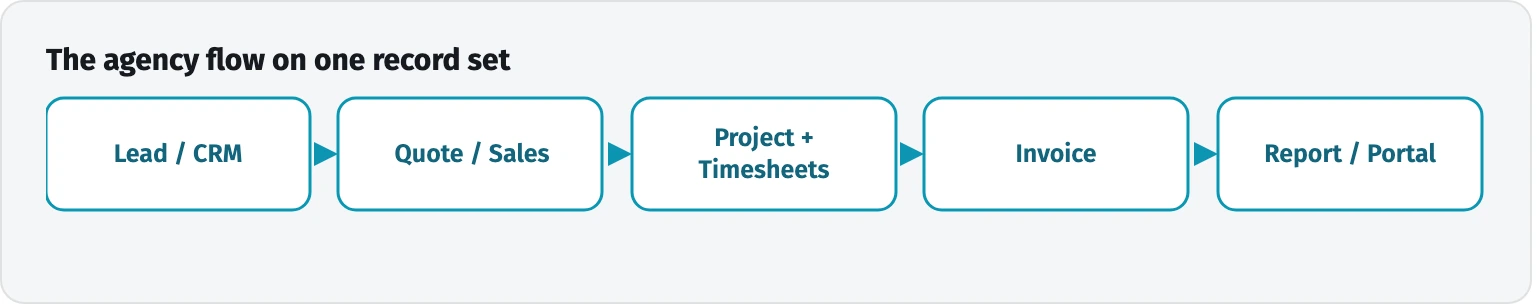
Five modules plus the built-in portal cover the full agency lifecycle, and most agencies sit right in the size band where this pays off. Among agencies surveyed, 46% have between 6 and 20 full-time staff (AgencyAnalytics, 2023), and the margin data later in this guide shows the smallest shops are also the most profitable. That band is the design center for a single connected system, because at six to twenty people the handoffs between sales, delivery, and finance happen often enough to hurt yet are simple enough to run on one record set. The core five are CRM, Sales, Project plus Timesheets, Invoicing, and Email Marketing, with the portal layered on top at no extra license cost. Agencies that also run people ops on Odoo can add HR for employee records and time off, though that sits outside the core agency flow.
The agency flow on one record setLead / CRMQuote / SalesProject +TimesheetsInvoiceReport / PortalSix Odoo modules cover the agency lifecycle from lead to quote to project to invoice, with the built-in portal giving clients read-only access. Source: Odoo documentation, retrieved 2026-06-26.
The table below maps each module to the job it does inside an agency.
| Module | What it does for an agency | Why it matters |
|---|---|---|
| CRM | Multi-client pipelines, lead and opportunity tracking across accounts | One view of every account, no spreadsheet handoffs |
| Sales (quotes plus e-sign) | Scoped quotes with online signature; confirming the first sale can auto-create the delivery project | Quote-to-cash starts in the same record, not a separate tool |
| Project plus Timesheets | Per-client workspaces, time tracking, and project profitability that compares revenue against timesheet and purchase cost | You see margin per client, not just hours logged |
| Invoicing | Milestone, fixed-price, and time-and-materials billing; billable versus logged hours. Recurring/subscription billing requires Odoo Enterprise (Subscriptions app) | Bills the way agencies actually charge |
| Email Marketing | Campaign sends, segmentation, and templates | The layer where the agency runs its own marketing |
| Portal (built in, not a paid module) | Clients log in to view their projects, tasks, and invoices, read-only, shared per project | Client transparency without extra licenses |
Project profitability is the underrated one. Odoo computes it by comparing project revenue against timesheet and purchase costs through analytic accounts, so you read margin per engagement directly (Odoo documentation). For an agency, that single screen answers the question owners ask most: which clients actually make us money?
Why does timesheet and profitability tracking matter so much for agencies?
Because margin is thin and getting thinner, so every untracked hour bites. The average digital agency net margin fell to 13% in 2025, down from 14% in 2024 (Promethean Research, 2026). At that margin, a few percentage points of leaked time decides whether a client account earns money or quietly loses it. Timesheets are where that leak shows up first, since the hours your team logs are the raw input to both billing and profitability. When those hours sit in a separate tool from your projects and invoices, the gaps stay invisible until a quarter closes badly.
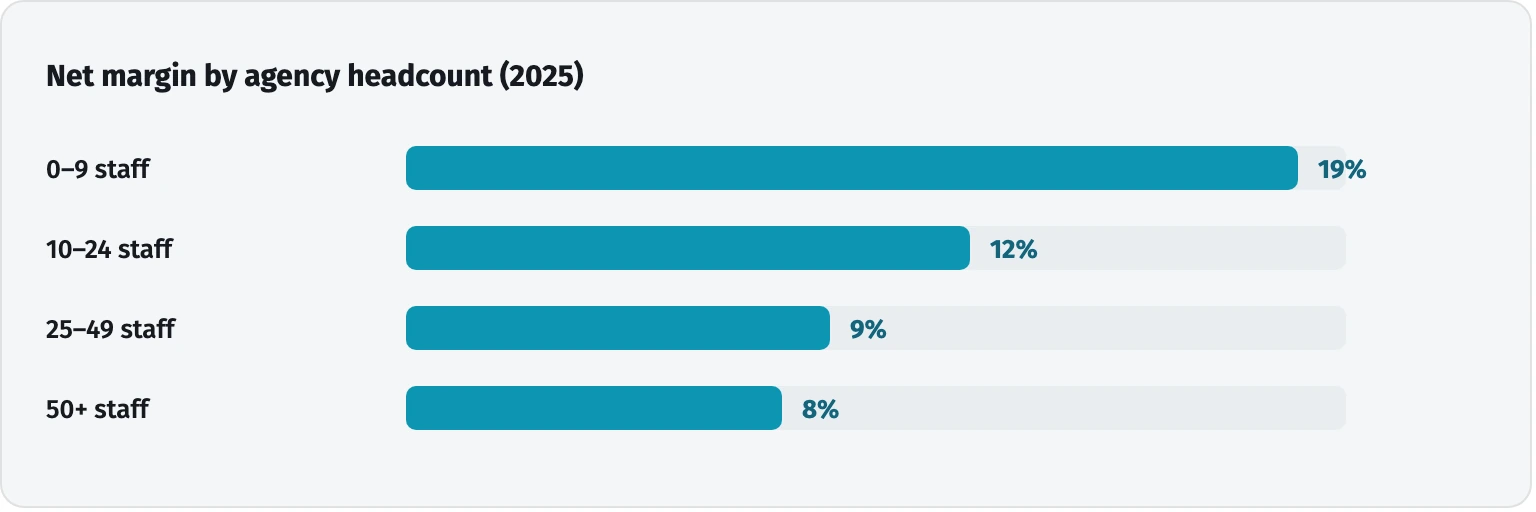
Net margin by agency headcount (2025)0–9 staff19%10–24 staff12%25–49 staff9%50+ staff8%The smallest agencies keep the most of each dollar, which leaves the least cushion for untracked time. Source: Promethean Research, 2026.
The size data sharpens the point. In 2025, net margin by headcount ran 19% for agencies with 0 to 9 full-time staff, 12% at 10 to 24, 9% at 25 to 49, and 8% at 50 and above (Promethean Research, 2026). Smaller shops keep more of each dollar, partly because overhead is leaner. The flip side is they have less cushion to absorb sloppy tracking, so the connected timesheet-to-invoice path matters all the more for them.
Utilization is the lever underneath margin. When timesheets, projects, and invoices live in one system, you see billable versus logged hours as they happen. You bill accurately, and you catch the leak before it compounds.
How hard is it to move from another CRM to Odoo?
The data move is the easy part, and the process redesign is the work. Agencies run lean tool stacks that nonetheless sprawl across many overlapping SaaS apps. Consolidating onto Odoo means deciding what each tool was really for, which is a question most agencies have never had to answer in one sitting. The core records move quickly by CSV at agency volumes, so the import itself rarely stalls a project. The harder part is rebuilding the platform-specific assets that do not port one to one, and resisting the urge to recreate every old workflow rather than the ones that still earn their keep.
At agency contact volumes, the core records move quickly. Companies, contacts, deals and their stages, notes, and basic activity history all migrate by CSV import. What you rebuild rather than migrate are the things tied to a specific platform: marketing-automation workflows, email templates, lead-scoring rules, landing pages, and forms. Those do not port one to one, so plan to redesign them inside Odoo’s CRM stages and the Sales-to-Project-to-Invoicing flow.
One long-tail cost is worth naming up front: customizations. Every deep customization you add to Odoo has to be re-migrated at each version upgrade, which is a recurring effort and risk. A zero-customization setup stays upgrade-safe by design. There is no public, sourced benchmark for a typical CRM-to-Odoo migration time or cost, so treat any single number you see with caution and scope your own from your real record counts.
What does Odoo cost an agency in year one? Three paths
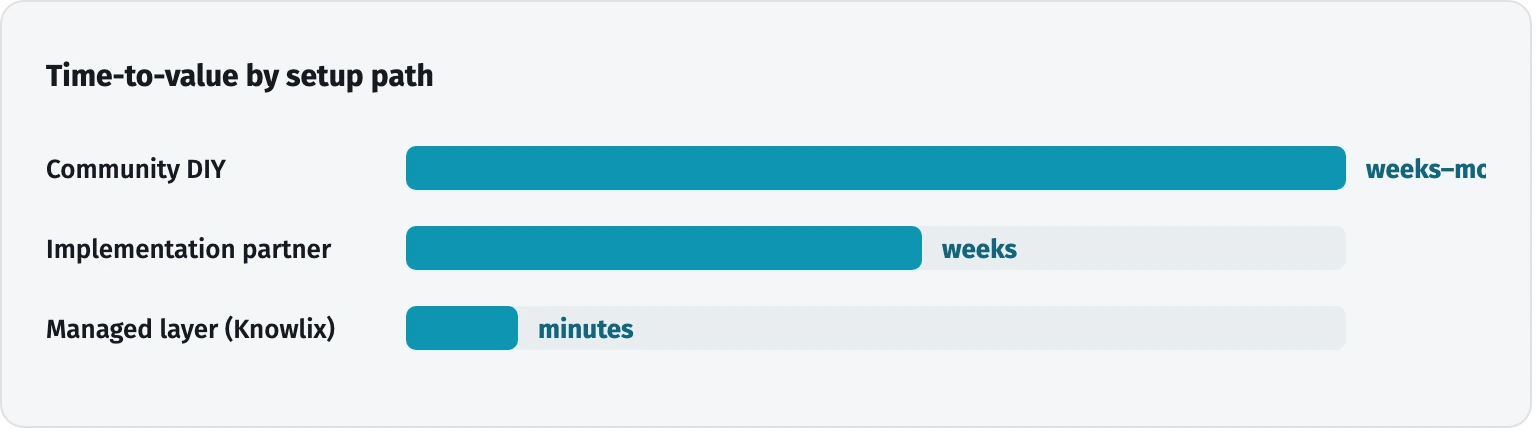
It depends entirely on which path you take, and the three diverge sharply on time-to-value. For context, the average digital agency books about $4.43 million in revenue and roughly $575,000 in after-tax profit at a 13% margin (Promethean Research, 2026). Against numbers like those, the license is rarely the bigger cost. What costs more is the weeks your team spends getting live, billing slowly, and working around half-built processes. The three paths are Community DIY, Odoo plus an implementation partner, and a managed layer such as Knowlix, and they trade money against time in different ways.
| Path | Timeline | Year-one cost (indicative) | Best for |
|---|---|---|---|
| A. Community DIY | Weeks to months | $0 software, plus self-hosting around $20 to $80 (€70)/mo, plus your team’s time; upgrade-migration risk if you customize | A technical agency with its own ops or IT capacity, willing to invest time to learn Odoo’s technical details |
| B. Odoo plus an implementation partner | Weeks, partner-led | Odoo subscription (priced in EUR; USD geo-locked and unverified at writing) plus a US partner at an indicative $100 to $175 per hour; engagement size varies widely, so scope it against your real requirements | Agencies wanting Enterprise depth (Studio, full Accounting) and a hands-on partner |
| C. Managed layer (Knowlix) | Live in minutes, then expand from there | $24.90 (€24.90) per user per month, with a 7-day free trial; roughly $249 (€217)/mo at 10 seats | Agencies under 50 with no IT team that want the fastest time-to-value |
Two pricing caveats matter for honesty. Odoo’s own subscription tiers are published in EUR and the USD page is geo-locked, so we do not quote a US figure we cannot verify. US partner rates vary widely, and the $100 to $175 range is indicative, not a quote; offshore partners can run lower, specialized US partners higher. Whichever path you pick, scope the partner or self-host hours against your real requirements rather than a headline rate.
If you go module-by-module, a four-week build works well: week one for CRM and data import, week two for Sales quotes with e-sign and your first quote-to-cash, week three for Project, Timesheets, and profitability, and week four for Invoicing plus the client portal. A managed layer compresses the first two weeks into the initial setup, since the flow ships preconfigured.
Where Knowlix fits for marketing agencies
Disclosure first: Knowlix is path C, so read this as the interested party that it is.
Here is the direct version. For an agency of 5 to 50 people with no IT team, path C is the one that gets you running this week instead of next quarter. Paths A and B ask you to build Odoo yourself or pay an implementation partner to build it over weeks. Knowlix gives you the same lead-to-quote-to-project-to-invoice flow, configured and live, in minutes.
One mechanism makes that possible: Knowlix sits on top of Odoo Community, hosted, and acts in plain language by writing directly to the Odoo database. You say “draft the quote for the deal we just won and send it after I confirm,” and it creates the quote in Odoo Sales, carries the won deal into a delivery project, and waits for your confirmation before anything irreversible. It runs behind permission gates, so it never sends an invoice or a quote, and never deletes data, without your sign-off, and each user sees only what their rights allow. It makes zero customizations, which keeps you upgrade-safe as Odoo ships new versions and skips the migration tax a custom build creates.
That full flow, with the client portal, runs live in Knowlix today on Odoo Community. Start on a 7-day free trial at $24.90 (€24.90) per user per month (Knowlix pricing), or see how the setup works on the Knowlix Odoo Partner page.
Where Knowlix is not the answer: if your agency runs a large custom Odoo build with its own developers, paths A or B give you more control. And if your core need is heavyweight marketing automation rather than connected operations, weigh a dedicated platform. For the base system, start with our small-business Odoo setup guide.


Frequently asked questions


Odoo suits agencies that want sales, project delivery, and finance on one record set, since CRM, Sales, Project, Timesheets, and Invoicing share the same data. A solo or three-person shop may run faster on single-purpose tools, and Odoo is a lighter marketing-automation engine than dedicated platforms.
Start with CRM for pipelines, Sales for quotes and e-signature, Project plus Timesheets for delivery and profitability, and Invoicing for milestone and time-and-materials billing. Email Marketing covers campaigns, and the client portal is built in, not a paid module.
It ranges from minutes to months depending on the path. A self-hosted DIY build runs weeks to months, a partner-led project runs weeks, and a managed layer can be live in minutes. A practical module-by-module build takes about four weeks.
Partly, and the edition matters. Odoo Community Invoicing covers milestone, fixed-price, and time-and-materials billing. Automatic recurring or subscription billing is an Odoo Enterprise feature via the Subscriptions app and a dedicated license, not Community.
The data move is fast at agency volumes: companies, contacts, deals, stages, notes, and activity all import by CSV. The real effort is rebuilding platform-specific assets like automation workflows, email templates, and lead-scoring rules, then redesigning the process around Odoo's CRM stages.
It depends on the path. Community is free as software but costs self-hosting around $20 to $80 per month plus your team's time. A partner adds hours at an indicative $100 to $175 per hour in the US. Knowlix runs $24.90 per user per month with a 7-day free trial.
Subscribe for Our Newsletter
Book your call below.


Check your website health score
Scan your site in seconds and make sure you're beating your competitors.
