
AI Agents for Project Management: Automate Tasks & Decisions

When you run a business, communication happens across multiple channels, and important details are often in emails, chat threads, and meeting notes.
As workload increases, so do missed deadlines, duplicated effort, and last-minute surprises.
If you run a small business, hiring more coordinators or project managers is expensive, but at the same time operating without structure creates chaos.
The solution lies in automation tools. However, most traditional automation tools only react after something goes wrong.
That’s where AI agents for project management come into play, proactively bringing useful insights and flagging risks before they become problems.
provide a much more efficient alternative that brings useful insights and helps you spot risks early on.
Read on to see how these agents can automate tasks, support decisions, and transform the way you run your projects.
Key Takeaways
- AI agents do more than basic automation
Traditional rule based automation reacts to triggers. AI project management agents analyze context, patterns, and historical data to anticipate delays, recommend priority shifts, and support smarter decisions before issues escalate. - They automate tasks, decisions, and reporting in one system
AI agents can convert emails and meeting notes into structured tasks, assign work based on real capacity, recommend realistic deadlines, and generate live project updates. This reduces manual admin work and minimizes missed details. - Small businesses gain enterprise level insight without extra hires
By continuously analyzing workload, timelines, and performance trends, AI agents surface strategic insights that would normally require analysts. You can see which projects are profitable, where delays repeat, and how to scale more efficiently. - Predictive risk detection prevents last minute chaos
Instead of simply identifying overdue tasks, AI agents detect patterns that signal upcoming delays, overload, or timeline conflicts. This early warning system improves on time delivery and protects client relationships. - Knowlix turns AI into a fully integrated execution system
Knowlix combines project management, CRM, sales, invoicing, and communication into one platform with a built-in AI Teammate. It does more than store data. It answers calls, creates leads, drafts invoices, updates pipelines, and executes tasks across departments without manual handoffs or extra integrations.
What are AI agents for project management?
AI project management agents are intelligent, context-aware digital assistants embedded within work management platforms.
Which platform you run them in decides how much they can touch, and our comparison of nine AI project management tools covers the ones worth shortlisting.
They continuously monitor your tasks, deadlines, messages, documents, timelines, workloads, and use AI models to interpret what’s happening in real time.
Instead of waiting for someone to manually trigger an action, AI agents:
- Monitor project progress
- Detect emerging risks
- Analyze team workload distribution
- Provide insights that would otherwise be much harder to find among data
Traditional automation vs. AI agents
Here’s a quick overview of the areas where traditional and AI project management agents differ the most.
CategoryTraditional automation (Rule-based)AI project management agents (Intelligent systems)How it worksExecutes predefined “if–then” rulesAnalyzes data, patterns, and context continuouslyFlexibilityOnly responds to exact triggers, rigidAdjusts recommendations based on changing conditions, adaptiveLearning capabilityDoesn’t learn over timeLearns from historical project data and behavior patternsContext awarenessCan’t interpret conversations or nuanceInterprets natural language, meeting notes, and communication threadsDecision supportOnly executes commands, no decision-makingSuggests priority shifts, deadline adjustments, and workload balancingRisk detectionIdentifies issues only after conditions are metPredicts potential delays before deadlines are missedWorkload managementAssigns tasks based on static rulesRecommends assignments and re-assignments based on real-time capacity and past performanceReportingGenerates basic status notificationsCreates summaries, insights, and executive-ready reportsSmall business impactSaves time on minor admin tasksReduces risk, improves decisions, and increases operational leverage
Traditional automation relies on rule-based systems and predefined instructions, such as:
- “If a task is overdue, send an email.”
- “If a form is submitted, create a task.”
- “If status changes to ‘Done,’ notify the manager.”
The main weakness of these systems is their rigidity. They only respond when exact conditions are met. They don’t learn and don’t interpret nuance.
On the other hand, AI project management agents can:
- Analyze patterns over time
- Interpret natural language
- Recognize trends
- Give recommendations and adapt based on context
For example, instead of marking a task as overdue, an AI agent can recognize that the same type of task has been delayed three times this quarter or that two related tasks are blocked.
Depending on the type of AI agent, it might recommend redistributing work or adjusting deadlines.
Note: Traditional automation reacts while AI agents anticipate and recommend.
How do AI agents for project management operate?
AI agents operate by analyzing multiple levels of project data simultaneously:
- Task metadata: Include deadlines, assignees, status changes, and dependencies
- Communication context: Analyze comments in task threads, meeting transcripts, emails, and chat discussions
- Historical patterns: Check average task completion times, frequency of delays, budget performance, and more
This way, AI agents can detect patterns humans may miss, especially if information is scattered.
What tasks can AI agents for project management automate?
AI project management agents usually automate three major areas: tasks, decisions, and updates.
1. Task management
In smaller teams, a team member often has to manually translate inputs, such as client emails or meeting notes, into tasks, decide who should handle them, and estimate a deadline.
With AI agents, the process becomes faster, simpler, and with fewer errors, if any.
Instead of waiting for someone to create a task, the AI can interpret incoming communication and automatically convert it into structured tasks.
Because the AI is continuously analyzing workload distribution and historical performance data, it can assign work to the most appropriate team member based on real data.
It understands who is currently overloaded, who has capacity, and who has completed similar tasks efficiently in the past.
So, instead of distributing work or assigning based on habit, the system distributes based on real data.
Another task management aspect where AI excels is deadlines. AI agents evaluate how long similar tasks have taken in the past.
If revisions typically take four days instead of two, the system can recommend a more realistic timeline to prevent underestimation.
AI agents can also detect bottlenecks and issues before they escalate.
For example, if certain task types are repeatedly delayed, the system identifies the pattern early.
This way, instead of asking, “Who’s handling this?” or “Why is this late?” teams can use a model where the system already knows:
- Who should own the work
- When it should be completed
- Where risks may arise
As a result, you can experience fewer missed details, fewer last-minute issues, and far less administrative overhead.
Did you know?
Knowlix’s AI Teammate agent can automatically capture leads from customer interactions and instantly add them to your visual sales pipeline.
It answers calls, takes structured notes, generates invoices, and books meetings without manual input.
You just need to assign a task to your AI Teammate in chat.
For example, you ask it to create a lead and quotation based on your last conversation with a client and the AI agent immediately does it.
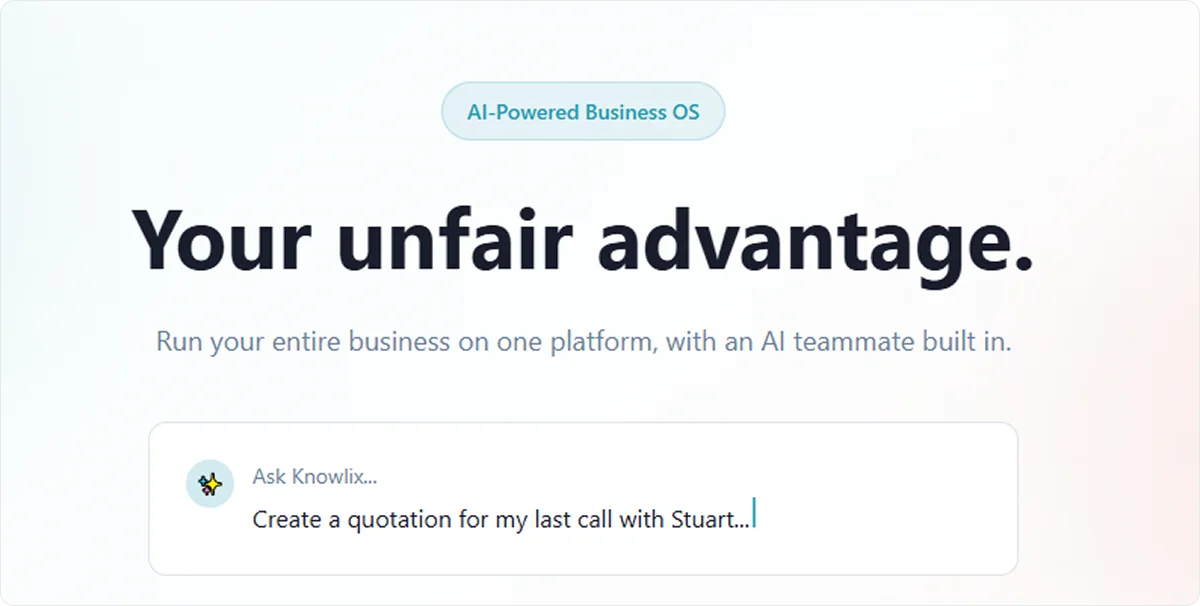
Because it’s powered by your CRM and connected across departments, it already understands the context, which means no repetitive explanations or disconnected tools.
2. Data-backed decision support
AI project management agents provide clarity by continuously analyzing your operational data in the background.
Because they monitor timelines, workload distribution, historical performance, and task dependencies simultaneously, they can spot insights that would be difficult to identify manually.
For example, an AI agent might detect that accepting a new project would push your design team beyond sustainable capacity based on current velocity trends.
Also, it might identify that two major deadlines overlap in such a way that previously resulted in delays.
Or, it might recognize that a specific type of project consistently exceeds its estimated budget.
The AI doesn’t make the decision for you. It highlights patterns, measures risk, and provides recommendations.
You remain in control, but you’re no longer operating with partial visibility.
This capability is especially useful for smaller teams that don’t have the luxury of hiring analysts for forecasting and planning.
However, with AI agents for project management, you can get enterprise-level insight without enterprise-level overhead.
3. Status updates and reporting
Weekly updates often involve asking team members for progress notes, manually reviewing task boards, copying metrics into documents, and rewriting similar summaries again and again.
Even when the information already exists inside your project management system, someone still has to gather, interpret, and present it.
AI project management agents eliminate much of this administrative burden by generating updates automatically from live data.
The system tracks task completion, timeline changes, milestone progress, and workload distribution, so it can synthesize that information into clear summaries without human effort.
As a result, you can review a ready-made summary that highlights completed tasks, upcoming deadlines, emerging risks, and key achievements.
If a client needs a progress update, the AI can generate a structured report tailored to that project’s data.
Besides saving time, automation increases:
- Consistency: Every report pulls directly from real-time data, reducing errors caused by manual copying or outdated information.
- Transparency: You can receive timely updates without waiting for someone to collect them.
- Accountability: When progress is visible and automatically tracked, there’s little room for errors.
When you’re a growing business, manual reporting scales poorly while AI-driven reporting scales much more efficiently.
No matter how many projects you have, the system continues to combine and analyze insights in the background.
AI agents for project management: What 5 main benefits do they bring to small businesses?
Unlike large enterprises, small teams don’t have as many levels of operational support, which means they feel every inefficiency and missed detail immediately.
That’s why AI agents for project management are a much more structural asset than an incremental one.
Here are the key ways you can benefit from AI project management agents.
BenefitWhat it improvesPractical impact for small businessesReduced human errorMinimizes missed deadlines, forgotten tasks, and duplicated effortFewer client issues, less rework, and smoother internal operationsScalable operationsAbsorbs coordination and administrative workloadEnables growth without immediately increasing headcountImproved strategic insightsTransforms project data into long-term performance intelligenceReveals which services are most profitable, where time is lost, and how to scale more effectivelyPredictive risk detectionIdentifies issues, overloads, and timeline conflicts earlyPrevents last-minute crises and improves on-time project deliveryIncreased operational visibilityProvides real-time dashboards and insightsGives owners clearer oversight without micromanaging
1. Reduced human error
Small teams operate quickly and have fluid communication, but work often moves faster than documentation.
Although speed is an advantage, it also increases the risk of missing details.
For example, you may notice an email request, but not formally track it, or two team members unknowingly duplicate effort.
The main culprit for these errors isn’t incompetence, but the side effects of limited bandwidth.
AI agents continuously monitor deadlines, task status changes, and communication threads, and catch gaps that humans might overlook.
This results in fewer preventable issues that lead to stronger client relationships and better internal operations.
2. Scalable operations without increasing headcount
By absorbing repetitive coordination work, such as task assignment, deadline monitoring, reporting, and risk detection, AI agents expand operational capacity without expanding payroll.
The system handles the administrative load that would otherwise require another hire.
Of course, this doesn’t eliminate the need for leadership or oversight, but it allows existing team members to focus on higher-value activities.
As a result, small teams can handle larger project volumes without proportional increases in administrative burden.
3. Improved strategic insights
As the system analyzes project data, certain patterns become more visible:
- You start to see which project types consistently generate the highest margins.
- You identify where timelines are regularly underestimated.
- You discover which services demand disproportionate resources.
- You gain clarity on how workload distribution impacts delivery speed.
Without AI, uncovering these insights would require manual data analysis. With AI agents, you can start optimizing projects and scale intentionally, backed by data.
4. Predictive risk detection
Due to their continuously monitoring nature, AI project management agents can detect early warning signs long before a problem appears.
For example, an AI agent might recognize that:
- A critical task has remained in the same status longer than similar tasks historically have.
- A team member is operating above sustainable capacity for multiple consecutive weeks.
- A project’s velocity has slowed compared to its original trajectory.
Individually, these signals might seem minor, but combined, they form a pattern.
Predictive risk detection connects these signals before humans typically would.
In addition to notifying you that something is late, AI agents also warn you that something is likely to become late.
5. Increased operational visibility
When your team starts growing, it becomes impossible to personally track every task, client request, and deadline.
However, without visibility, you’re forced to rely on fragmented updates or periodic check-ins to understand what’s happening.
Consequently, this often leads to over-involvement and micromanagement to maintain control or under-visibility and surprise problems.
AI project management agents improve operational visibility by transforming scattered project data into clear, real-time insight.
This kind of visibility doesn’t require constant oversight because the AI filters noise and highlights what actually matters.
How the Knowlix AI agent handles project admin for small service teams
Knowlix is an all-in-one business platform with a built-in AI teammate that runs CRM, sales, invoicing, projects, communication, and more in one place.
Unlike traditional tools that store data, Knowlix actively works with it.
Every member of your team gets the AI Teammate that creates leads, drafts invoices, answers emails, takes meeting notes, and executes tasks across apps.
As a result, the agent saves your employees up to one day every week.
It replaces standalone AI chatbots, AI phone call agents, website builders, email assistants, customer support bots, sales assistants, and marketing tools.
For example, the AI teammate can answer a call, transcribe it, extract key details, and automatically update your CRM or calendar without manual work or extra integrations.
Your AI teammate can reference past conversations when drafting emails, add requests to your project tracker, or update deal stages based on the discussion.
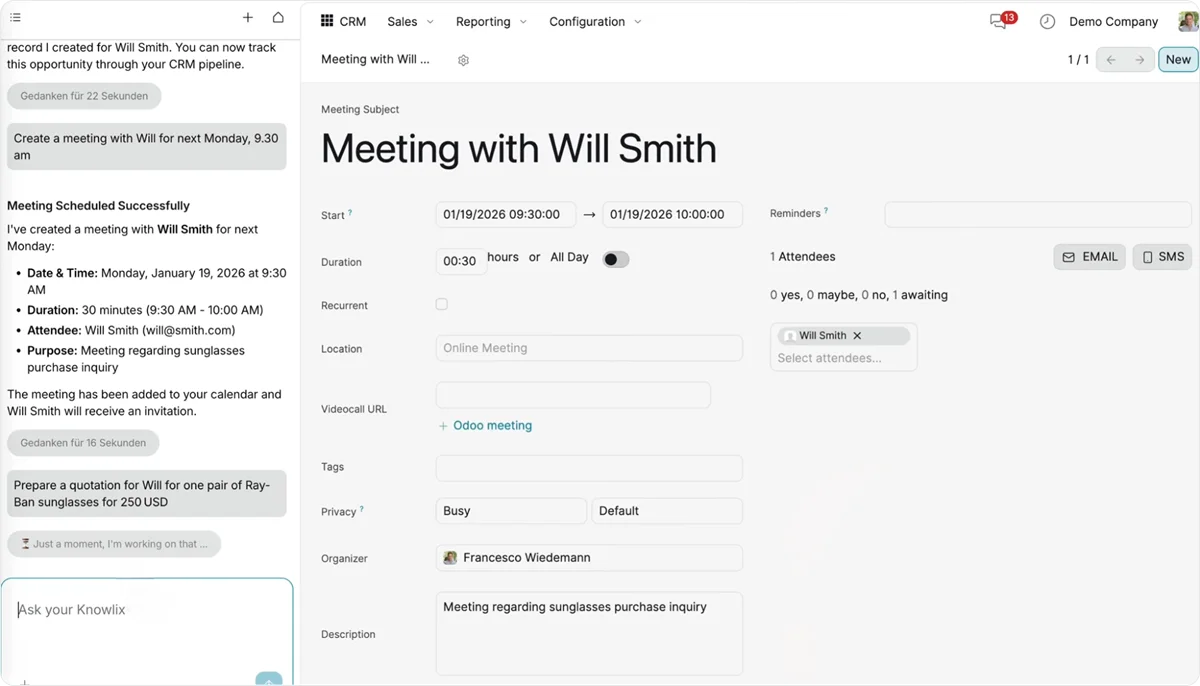
Curious to see our AI Teammate in action?
Sign up for Knowlix today to see how you can replace scattered tools, manual tasks, and disconnected AI with one robust, unified system.


Frequently asked questions


Yes, they can because of their ability to analyze trends beyond day-to-day operations. By checking historical project data, task completion patterns, workload distribution, and client cycles, AI agents can provide insights into future timelines, resource gaps, and risk areas.
Whether you’re using a cloud-based AI or an on-premises solution, it’s important to choose tools that follow strong security standards, encryption, and access control.
Look for features such as role-based permissions and audit logs, as they ensure the AI interacts only with relevant project data and maintains visibility controls.
Subscribe for Our Newsletter
Book your call below.


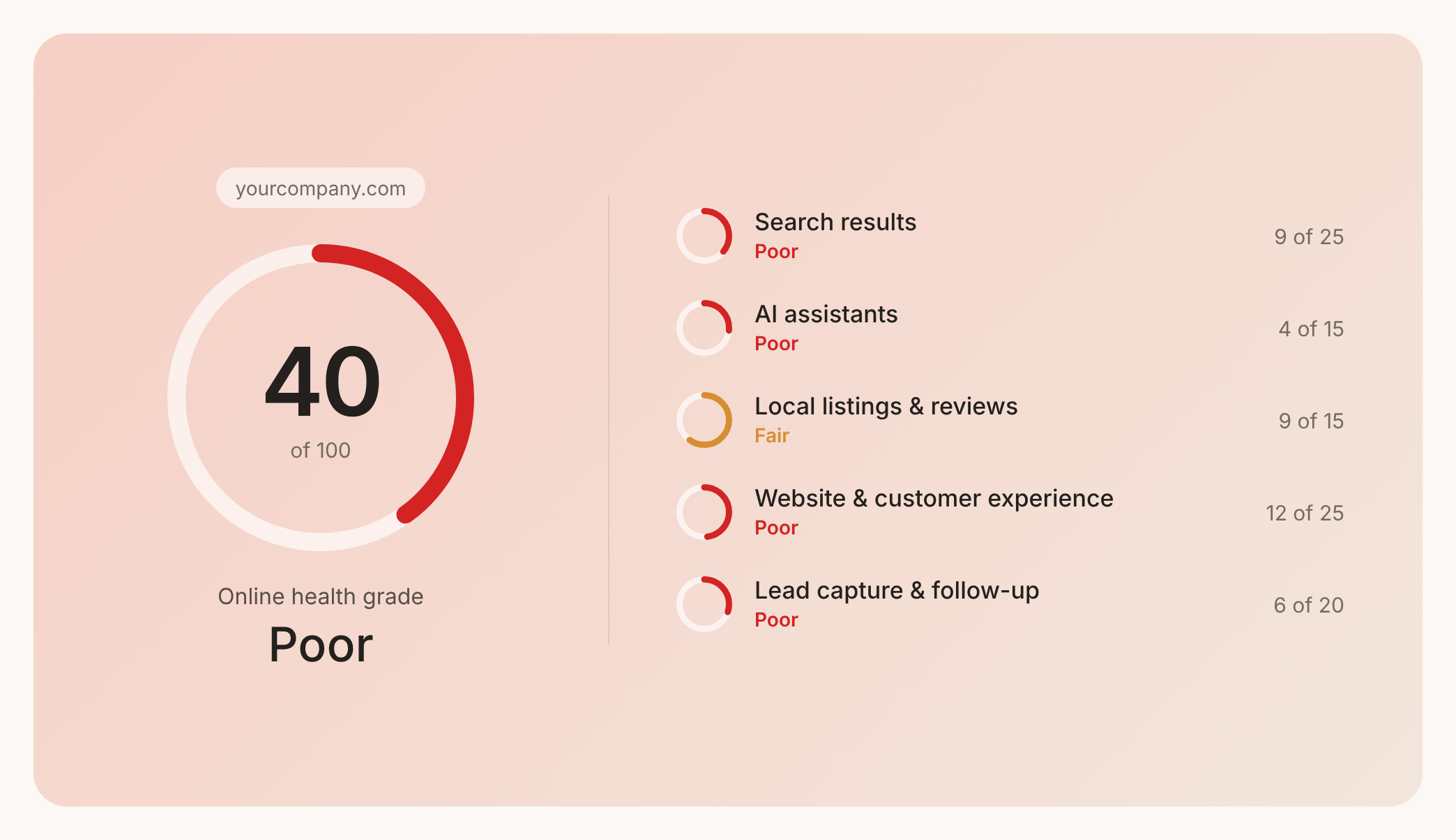

Check your website health score
Scan your site in seconds and make sure you're beating your competitors.
