
12 Essential CRM Best Practices To Boost Sales & Retention

When effective, customer relationship management can turn a small business into a profit machine and make it stand out in a crowded market. Still, a recent study suggests that 75% of businesses fail to use their system effectively and lose revenue as a result.
To avoid and overcome common challenges that can stifle your growth, here’s a list of 12 key CRM best practices to follow.
Key Takeaways
- Set specific, measurable CRM goals and form a team that can execute them successfully. Maintain relevance of your strategy by adjusting for shifts in the market and customer expectations.
- Go with a CRM that fits your team size, budget, and growth goals. Ease implementation by involving your team in the selection process and providing proper training.
- Customize your CRM to align it with your workflows and use automation and AI to work more efficiently.
- Maintain clean, consistent data and use analytics to inform your decisions.
- Segment customers and collect feedback to deliver personalized, memorable experiences.
- Knowlix combines these best practices into one platform with simple setup, powerful automation, and AI that actually understands your business.
CRM Best Practices for Planning
Follow these tips to ensure your teams operate and collaborate efficiently:
1. Define Clear Goals and Objectives
Every team needs a roadmap to organize its processes effectively and reach its full potential. Without it, growth is limited, and chaos often ensues.
You should set specific, measurable, and realistic goals with clear deadlines. These goals also need to align with your business’s high-level strategy.
Then, you can create an implementation plan:
- Prioritize goals
- Define ways to measure success
- Analyze previous efforts to identify the best way forward
- Turn the goals into actionable items to assign to your team
2. Update Your CRM Strategy
Customer expectations shift, market conditions evolve, and technologies emerge. What worked a few months ago might not be relevant today. Your strategy should evolve alongside these changes.
Block time every quarter to audit your CRM processes. Compare your current workflows and their results against the goals you set, identify what's slowing your team down, and cut what's not working. Additionally, you should stay informed about industry trends and tools to identify opportunities for improvement quickly.
Taking these extra steps will keep your business relevant and prevent you from losing ground to competitors.
3. Assemble a Customer-Centric Team
The success of your strategy will ultimately depend on the team executing it.
Don’t skimp on recruiting, onboarding, and training, especially when it comes to managers. An excellent manager can turn a solid salesperson into a top seller.
Look for people who are curious about customer problems, care about the relationships, and document interactions because they understand the value, not because they're told to.
For example, during the hiring process, ask candidates how they've maintained customer relationships over time. The best answers will include specifics about remembering details, anticipating needs, and staying in touch after the sale.
With each team member pulling their weight, you’ll deliver consistently excellent customer experience and pivot with minimal disruption. This is a must to succeed in a dynamic sales environment.
CRM Best Practices for Software
The software is the foundation of effective CRM. One survey suggests that 92% of companies consider their CRM essential to achieving their income goals.
These tips will help you make the most of your system:
4. Select Your CRM Wisely
With so many CRM platforms out there, it’s important to select yours carefully and consider all relevant factors:
- Team size
- Workflows and feature needs
- Technical skill level
- Budget for subscription
- Budget for setup and training
- Scaling plans
Some platforms, such as Zoho, offer many capabilities and a low entry point but entail a resource-intensive setup that few businesses are ready for. There are also many affordable, simple tools built for small teams, but they can be outgrown quickly.
Knowlix sits perfectly in the middle. It’s comprehensive and automates a wide range of tasks, yet offers simple pricing and setup. This means your team can get started and yield ROI quickly, and still scale easily when needed.
It’s also important to include your team in the selection process. By considering everyone’s opinion, you’ll increase buy-in and ease implementation.
5. Customize Your System
Your CRM platform needs to work for you, not against you. Otherwise, your team will not adopt it, and you won’t get your money’s worth. A tool may be powerful, but that won’t matter much if it doesn’t fit into your workflows.
The first step to ensuring success is selecting a CRM that offers plenty of customization and integration options. Open-source platforms like Odoo typically excel in this regard and provide unparalleled flexibility for businesses with unique requirements.
To adapt the platform to your needs, use options such as custom fields, views, dashboards, and automations, and integrate your tech stack.
Ensuring the right fit will expedite adoption, prevent data silos, and improve productivity and collaboration.
6. Invest in Training and Support
Many CRM systems have cluttered interfaces and complex workflows, which can make them difficult to learn. Typically, the more comprehensive a tool is, the more challenging adoption will be.
While selecting a user-friendly tool like Knowlix can ease the process, it’s still recommended to offer training, such as:
- Onboarding meetings
- Team workshops
- How-to videos
- Help center articles
- Community forums
- Webinars
Make sure your managers are proficient in the CRM so they can lead by example and offer team-specific support. They should also monitor the team’s performance and provide additional assistance to those who need it.
Another great practice is to create a strategy for your CRM software. Define how your team should use the system step by step, including who does what, when, and how. That way, you’ll ensure consistent data and smooth collaboration.
Finally, choose a CRM with responsive customer support by reading user reviews beforehand. Support will be especially valuable when it comes to upgrades and updates, as these can be difficult to implement. With strong support, you’ll be able to ensure smoother transitions, overcome issues quickly, and minimize downtime.
CRM Best Practices for Automation and Analytics
Recent technology developments have introduced many capabilities that previous generations of sales professionals could only dream of. Using them is necessary for staying ahead. The tips below offer some suggestions:
7. Use Automation and AI
Using automation and artificial intelligence saves you time, reduces errors, and ensures better decision-making. In turn, your team can be more productive and deliver excellent customer service, regardless of its size.
These technologies can streamline a wide range of tasks, including:
| Automation Capabilities | AI Capabilities |
|---|---|
| Data entry Lead routing based on location, industry, and rep workload Drip sequences triggered by customer actions like sign-ups Pipeline stage updates Task and meeting creation Quote and invoice generation Follow-up reminders after periods of inactivity | Data enrichment Predictive lead scoring based on historical data and behavior Sentiment analysis and alerts Personalized emails and messages Meeting notes and summaries Recommendations based on analytics AI agents that independently handle various tasks, and understand and update customer data |
Many CRMs have also implemented agentic AI, advanced systems that can perform multi-step tasks autonomously. AI agents can go as far as interacting with customers and resolving their technical issues. Some platforms even allow you to build custom agents.
With more time on their hands, your team can focus on building relationships, creating strategies, and improving processes.
8. Use Analytics and Reporting
Analytics allow you to uncover trends, track performance, and understand customer behavior and preferences. These insights are essential for effective decision-making.
You should go beyond basic reporting. Explore various types of analytics, including predictive and prescriptive, to see what’s coming and prepare for it. Additionally, build dashboards that pull real-time data from sales, marketing, and customer service bases to get a well-rounded picture of each customer and personalize interactions.
CRM Best Practices for Data Management
Implement these guidelines to make the most of your CRM data:
9. Prioritize Data Quality and Consistency
Low-quality data can be costly. In one survey, 37% of CRM users reported losing revenue as a result. To prevent this, follow the four C’s of CRM data:
- Currency
- Correctness
- Consistency
- Completeness
The first step is to standardize the data entry process. Define specific formats and methods, and validate and enrich new information as it comes in. Also, keep your data centralized and organized so it’s easier to access.
Most importantly, conduct regular audits to catch inaccuracies before they cause problems, and clean your data monthly or quarterly.
10. Ensure Data Security and Compliance
Data security and privacy should be your biggest priorities. Failing to ensure them can lead to severe legal and financial consequences.
To keep your data safe and compliant:
- Use all available measures, such as encryption, firewalls, and access controls.
- Provide your team with security training and guidelines.
- Conduct regular audits to detect issues early.
- Maintain clear data governance with consent management.
You should also prepare for the worst by developing an incident response strategy and backing up your data.
CRM Best Practices for Customer Engagement
Customer experience is the focus and foundation of CRM. Being cordial, addressing pain points, and providing fast service are necessary to ensure satisfied and loyal customers. These tips can help you get there:
11. Segment Your Customers
Divide your broad customer base into smaller, more manageable groups based on criteria such as demographics, age, behavior, and preferences. You can then use these segments for personalized outreach and interactions at scale. This will ensure the right message reaches the right customer at the right time.
One report suggests that 81% of customers prefer companies offering personalized experiences. Besides increasing customer engagement and satisfaction, segmentation will help improve your resource allocation and ROI.
12. Implement Feedback Loops
Ask your customers for feedback and implement surveys wherever you can to understand how to improve your customer service and which areas to prioritize. Consider these insights when creating your next strategy.
Put CRM best practices on autopilot
Knowlix keeps records clean and follow-ups on schedule with an AI Teammate, so the best practices happen without the manual discipline. $24.90 (€24.90) per seat per month.
Knowlix: An AI Platform Built on CRM Best Practices
Knowlix is an all-in-one, AI-first platform that provides you with the tools you need to achieve and maintain CRM success. It centralizes all your business data and apps across departments such as sales, marketing, and project management, and combines them with automation and AI for step-function efficiency gains.
Knowlix can automatically capture leads based on interactions and add them to the visual pipeline. It also answers calls, takes notes, creates invoices, and books meetings. When you need something done, you can assign it to your AI teammate via chat. It’s powered by your CRM and cross-departmental data, so it understands context and requires no explanation.
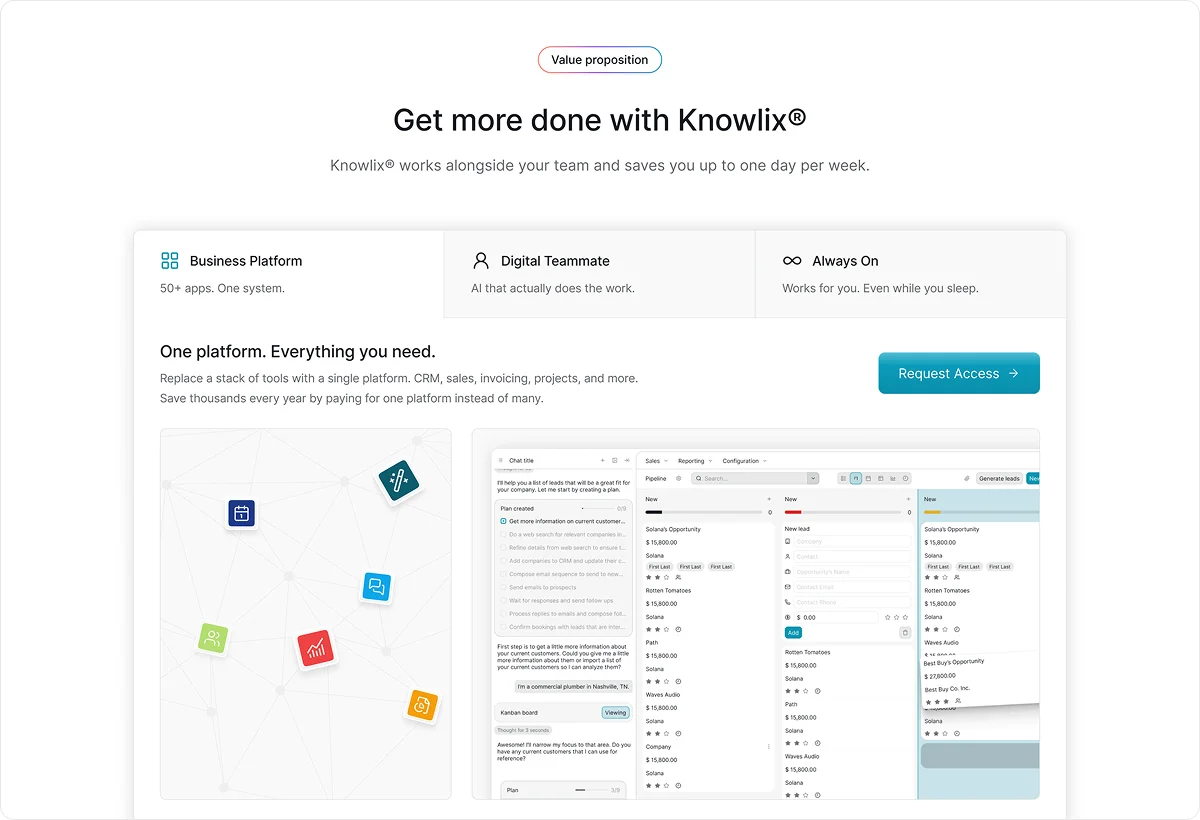
Although comprehensive, Knowlix is easy to use. It doesn’t require extensive training or implementation support, so your team can start using it immediately, regardless of skill level.
Knowlix also simplifies customization. You can activate or deactivate its 50+ apps with a single click. And since most of them are included in the basic plan, you don’t need to worry about added costs if you want to upgrade or scale.
Sign up for Knowlix today and give your business an unfair advantage.


Subscribe for Our Newsletter
Book your call below.


Check your website health score
Scan your site in seconds and make sure you're beating your competitors.
