
Best Langdock Alternatives in 2026: 7 Tools Compared

Most Langdock alternatives are the same product: per-seat access to a multi-model chat window at roughly €25 per user, and since April 2026 several meter your usage by tokens or credits. Knowlix is the different-category pick for small businesses. For about the same seat price, an AI Teammate runs back-office work inside the apps it ships with. If you need governed LLM chat for 1,000+ employees, Langdock or ChatGPT Business is the better call.
Disclosure: Knowlix is our product and ranks first in this list, so read the Knowlix section as the interested party it is. Every price and claim carries a source with retrieval date, the criteria apply to all tools equally, and the cons in our own section are real. All competitor data comes from public vendor pages, last verified 2026-07-10.
Last updated: 2026-07-10
The main Langdock alternatives in 2026 are Knowlix, nele.ai, meinGPT, DeutschlandGPT, ChatGPT Business, Microsoft 365 Copilot, and Dust. Since April 2026, the tools most people compare against Langdock have quietly changed what a seat buys. Langdock switched to token-based usage limits, so the money you pay each month no longer buys predictable usage. That single change is the trigger behind most alternative searches this year, and it is worth understanding before you shortlist anything.
Langdock itself deserves a fair word first. It is a GDPR multi-LLM workspace out of Berlin, with EU hosting, ISO 27001 and SOC 2, and real traction: $40M ARR announced in June 2026 across 10,000+ customers (Dealroom, Langdock hits $40M ARR). This is a mature, credible platform.
This comparison uses current, source-dated pricing from every vendor, retrieved July 2026. It covers six chat-and-agent workspaces plus one different-category option, and tells you plainly which fits which buyer.
Why people look for a Langdock alternative
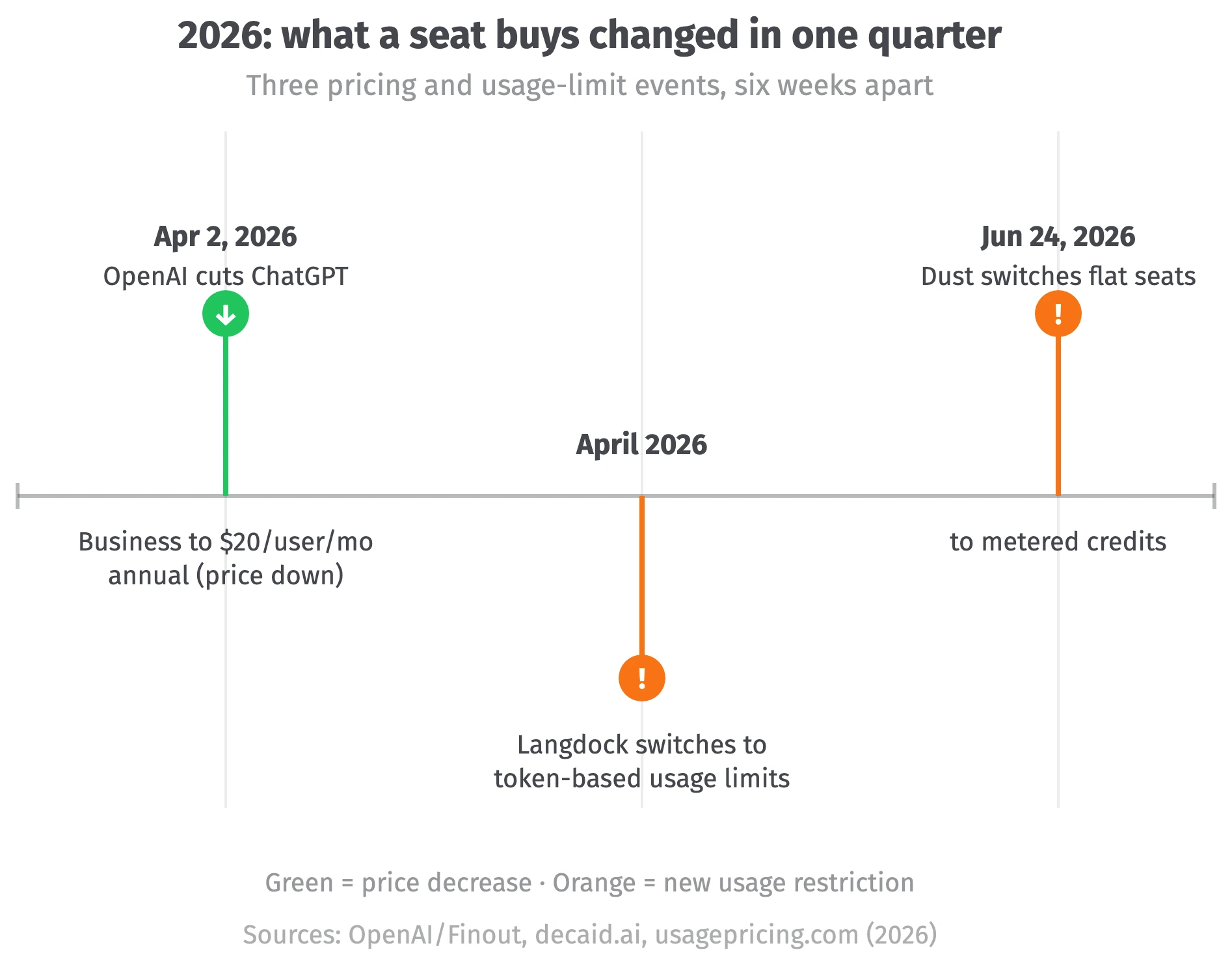
Three concrete triggers drive most of these searches. First, Langdock switched to token-based usage limits in April 2026, so a seat stopped buying predictable usage. Second, real automation is a separate line item behind an add-on. Third, a chat workspace advises, while the admin work still lands on a person. To restate the setup: Langdock is a GDPR multi-model chat workspace where employees talk to GPT, Claude and Gemini under one roof. Its April 2026 change added a five-hour session window plus a weekly window, weighted token consumption by provider cost, auto-routed users to GPT-5.2 once they hit the cap, and introduced pay-as-you-go "Extra Usage" overages (Langdock, "Pricing", langdock.com/pricing, which states fair-usage limits apply; teardown detail from decaid.ai, Langdock Nutzungslimits 2026). Buyers who signed for a flat seat found the meter running instead.
The demand context is real. As of late 2025, 88% of organizations use AI in at least one business function, up from 78% a year earlier (McKinsey, The State of AI: Global Survey 2025). Two more triggers round out the picture. The Langdock seat includes a Workflows Starter tier with 2,500 runs a month; workflow automation beyond that starts at €539/mo, so the €25 seat is fundamentally a chat and agent workspace. And a chat workspace has a ceiling: a third-party teardown by Workativ describes Langdock as well suited for secure internal AI chat and knowledge access, while companies that need end-to-end workflow automation, from approvals to system updates, tend to pick other platforms (Workativ, Langdock alternatives). That assessment names the gap searchers feel. If your problem is apps that don't talk to each other, a faster chat window over that stack leaves the work undone.
That is the gap Knowlix fills: the AI Teammate does the admin inside your tools instead of chatting about it. You can start a 7-day free trial.
Which Langdock alternative is right for you?
Here is the one-line verdict for each tool, so you can jump to the section that fits. Two of the billing terms below need a quick gloss. "Token-metered" means a seat with a usage cap measured in model tokens, and "credit-metered" means a wallet of credits you spend per action. "Flat" means a fixed seat with no meter, and "add-on" means core automation costs extra on top of the seat. Every price below is verified on the vendor page for July 2026 unless marked secondary-confirmed, and each carries its billing model so you can compare the total monthly bill, headline seat plus meter.
- Knowlix — Best when the goal is fewer admin hours: an AI Teammate runs back-office work across CRM, invoicing and projects at one flat seat price.
- nele.ai — Best for teams with many occasional users who want no per-seat cost.
- meinGPT — Best DACH self-service workspace with a built-in rollout academy.
- DeutschlandGPT — Best cheap, Germany-hosted seat plus a permanent free tier.
- ChatGPT Business — Best raw model access and ecosystem at the lowest big-vendor price.
- Microsoft 365 Copilot — Best for organizations already living inside Office.
- Dust — Best agent-builder for tech-forward teams that assemble their own agents.
| Tool | Entry seat price | Billing model | What the AI does | Hosting / GDPR | Best for |
|---|---|---|---|---|---|
| Knowlix | $24.90/seat/mo | Flat | Executes work in apps | EU / GDPR | Fewer admin hours |
| Langdock (reference) | €25/user/mo | Token-metered since Apr 2026 | Answers questions | EU / GDPR | Governed enterprise chat |
| nele.ai | From €10/mo (1,000 credits) | Credit-metered, no per-seat | Answers questions | Germany / GDPR | Many occasional users |
| meinGPT | €29/user/mo (incl. €9 credits) | Credit-metered on top | Answers questions | Germany / GDPR | Guided DACH rollout |
| DeutschlandGPT | €16/mo annual (Pro) | Fair-use | Answers questions | Germany / GDPR | Cheap German-hosted seat |
| ChatGPT Business | $20/user/mo annual | Seat (usage tiers) | Answers questions | US | Raw model access |
| Microsoft 365 Copilot | $18/user/mo annual add-on | Add-on to M365 | Answers questions | US (EU Data Boundary option) | Existing Office orgs |
| Dust | $24/mo annual (Pro) | Credit-metered since Jun 2026 | Builds agents (you assemble) | EU / US | Building your own agents |
Langdock alternatives compared: entry price, billing model, and what the AI does (verified July 2026; prices as sourced in EUR or USD, not converted)
Try Knowlix free for 7 days, and see the AI run the admin work inside your own apps at knowlix.ai.
How we compared these tools
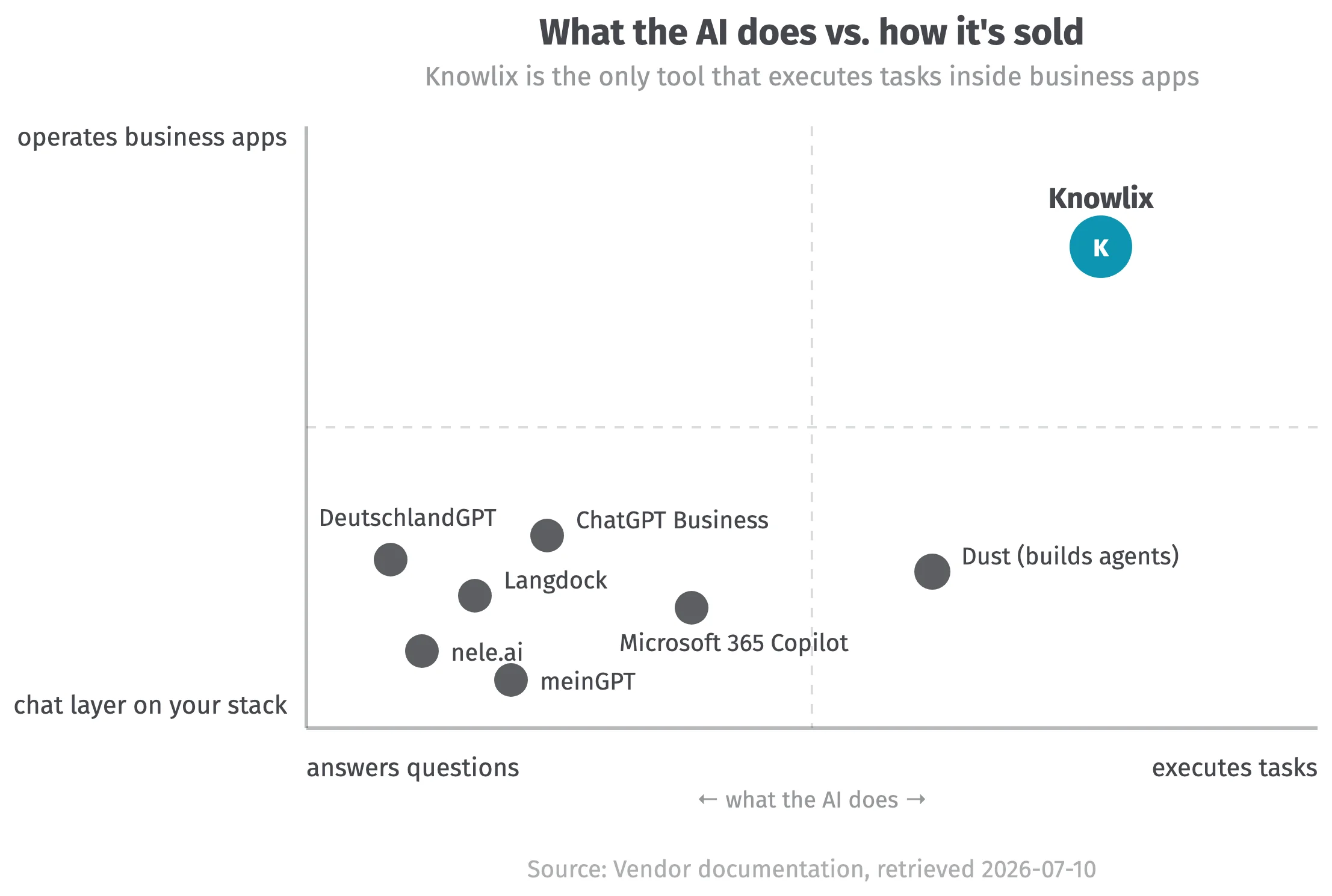
Three tests drove the ranking: seat math with usage risk, what the AI actually does, and fit to the buyer. Seat math means the seat price plus whatever the usage meter or add-on costs at real volume, and who carries the overage risk, the buyer or the vendor. The second test asks whether the AI answers questions or executes tasks inside business apps. The third asks who you are: a small business owner with five to fifty staff, or an enterprise rolling governed chat out to thousands.
Every price here was verified on the vendor's pricing page on 2026-07-10. Two exceptions carry a plain label: ChatGPT Business and the Dust amounts come from secondary sources because the vendor pages blocked direct fetch. We say so in each section so you can weigh the sourcing yourself.
1. Knowlix — best for small service businesses that want fewer admin hours
Best for: Small businesses that want the back-office work done for them.
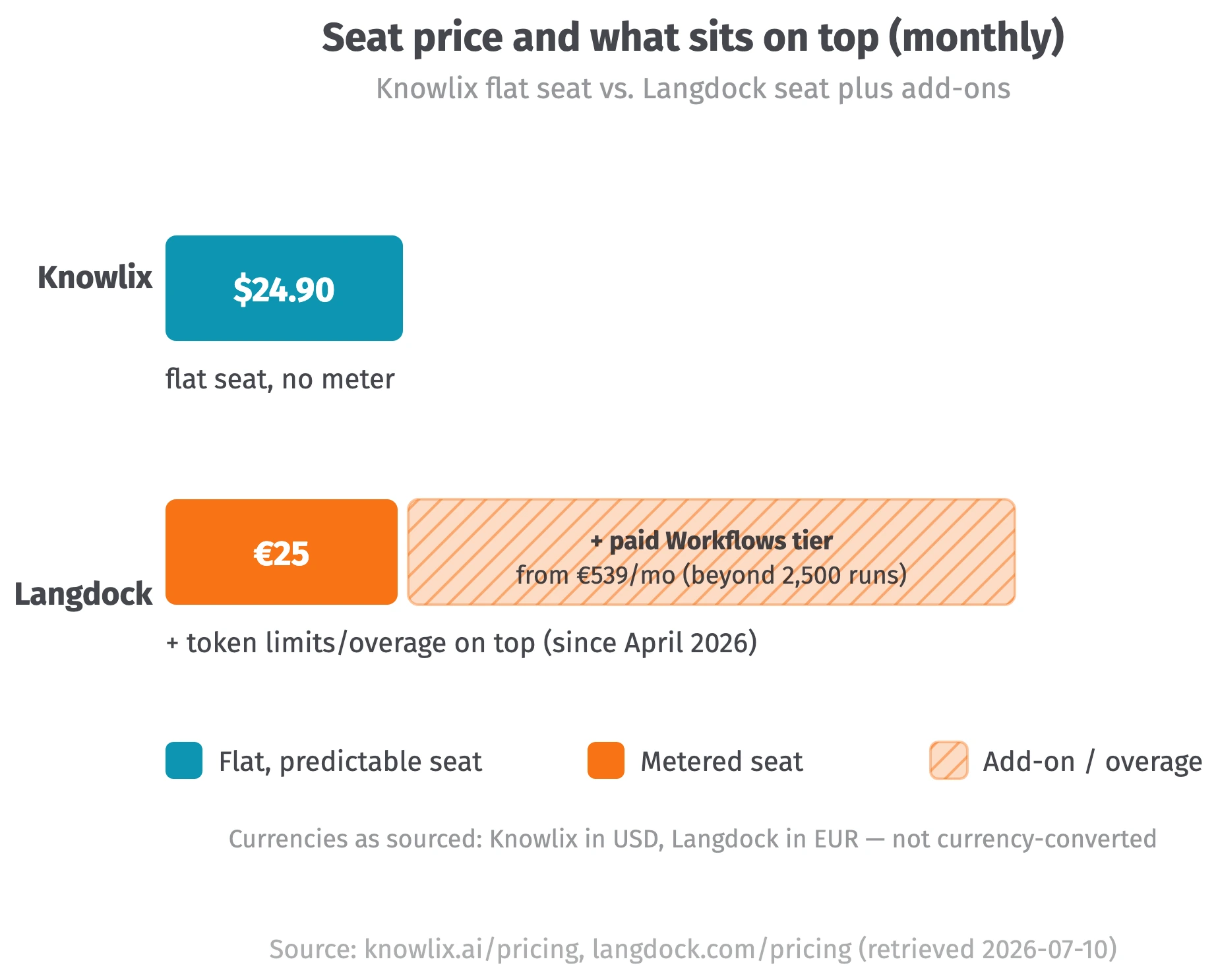
Pricing: 7-day free trial (), then $24.90/seat/mo (reduced from $35.60); Pro custom (knowlix.ai/pricing). The seat is flat with no usage meter.
Knowlix is an all-in-one AI Business Platform for small businesses. It bundles 25+ built-in apps on the Teammate plan (50+ on Pro): CRM, invoicing, expenses, projects, inventory, scheduling. On top of that stack sits an AI Teammate that executes back-office work inside those apps. Per the product page, it drafts and sends invoices, chases the unpaid ones, updates records after conversations, and moves projects forward (knowlix.ai). Every other tool in this comparison sells access to a chat window over a business's existing app stack, priced per seat, per credit, or under fair-use caps. For roughly the same seat money, Knowlix has the AI operate the apps it ships with, and the 7-day trial needs (knowlix.ai/pricing). The claim it grounds is simple: desk workers spend 41% of their time on low-value, repetitive "work of work" (Slack Workforce Lab, New Slack research).
The cost shape is what sets it apart. A flat seat is one bar on a chart. A Langdock-style setup for real automation is a €25 seat plus a Workflows tier that starts at €539/mo once you pass the included 2,500 runs a month, and the token meter sits on top of both. Predictable spend and metered spend are two different budgets.
Key features
- 25+ built-in apps on the Teammate plan (50+ on Pro): CRM, invoicing, expenses, projects, inventory, scheduling.
- AI Teammate drafts invoices, chases the unpaid ones, and updates records.
- Executes back-office work directly inside the apps it ships with.
- Flat per-seat price with hosting, support and maintenance included.
Pros and cons
| What we like | What could be better |
|---|---|
✓ The AI does the work itself: follow-ups, invoice chasing, record updates. ✓ Flat, predictable seat price with a 7-day no-card trial. | – Young product with a small third-party review footprint. – Wrong pick for governed multi-model LLM chat across 1,000+ employees; Langdock or ChatGPT Business fits that need better. |
Our verdict: The strongest pick for a small business whose bottleneck is the admin work itself, and the only tool here whose AI operates the business apps directly.
Why trust Knowlix?
Knowlix is an official Odoo partner, built in Germany since 2021. It is built by operators who have shipped before: CEO Francesco Wiedemann grew Kyte to $50M revenue, raised $370M, and sold it to Turo; CTO Peter Meier founded Metaio, acquired by Apple in 2015, and led an algorithm team there for four years. Real businesses already run on it, including Microfab and studios like Oneshot Design.
2. nele.ai — best for many occasional users
Best for: DACH teams that want compliant AI access without per-seat billing.
Pricing: Credit-based, no per-user cost, unlimited employees; from 1,000 credits at €10/mo up to 750,000 credits at €3,750/mo; Knowledge Database add-on €19.95/mo (2 GB cap); 7-day trial (nele.ai/pricing).
nele.ai is a GDPR AI gateway to ChatGPT-class models for German businesses, priced by credit. That makes it cheap when many people each use it lightly, because the bill tracks consumption and headcount stays out of it. Credit packages run from 1,000 credits at €10/mo up to 750,000 credits at €3,750/mo, with monthly cancellation and a 7-day trial that includes 1,000 credits (nele.ai/pricing). Prompt management ships in the box.
Credit budgeting has a catch: it shifts the usage risk to you, the same class of problem Langdock users flagged after the April 2026 switch. The trust footprint is thin, with zero reviews on OMR at last check (verified 2026-07-10). And the optional Knowledge Database add-on costs €19.95/mo and caps at 2 GB, which limits how much of your own material you can load in. For a team of many light users on a budget, the trade holds up.
Key features
- No per-seat cost, unlimited employees, prompt management.
- Transparent credit packages with monthly cancellation.
Pros and cons
| What we like | What could be better |
|---|---|
✓ Cheap for teams with many light users. ✓ Monthly cancellable, clear credit tiers. | – The buyer carries the usage risk on the credit meter. – Thin third-party trust footprint and a 2 GB knowledge cap. |
Our verdict: A sound pick when you have many occasional users and want to skip per-seat pricing.
3. meinGPT — best DACH self-service workspace
Best for: German SMEs that want a clean self-service AI workspace with rollout support.
Pricing: Self-Service €29/user/mo including €9 AI credits, no seat minimum, 10-day trial; Enterprise from €500/mo platform floor (meingpt.com/pricing). Credits bill at 1 credit = €0.01.
meinGPT is a GDPR AI workspace giving German SMEs access to GPT-5, Claude and Gemini, with role-based access control, EU hosting, and ISO 27001 certification. The self-service tier has no seat minimum, so a small team can start today without a sales call. Its differentiator is the meinGPT Academy: built-in training that walks a company through rollout, which matters when adoption is the real bottleneck. Credits bill transparently at 1 credit = €0.01, and the 10-day trial needs no card (meingpt.com/pricing).
Two costs weigh against that. At €29/user/mo including €9 of AI credits, it is the most expensive per-seat entry in this set, with usage credits stacking on top. And the Enterprise tier carries a €500/mo platform floor, which prices out genuinely small teams before per-user rates start to fall. For a DACH company that values a guided rollout and a clean workspace, the entry price buys real structure.
Key features
- Multi-model access with assistants and workflows.
- meinGPT Academy training plus EU hosting and ISO 27001.
Pros and cons
| What we like | What could be better |
|---|---|
✓ No seat minimum on self-service; transparent 1 credit = €0.01 pricing. ✓ Built-in academy smooths the rollout. | – Highest entry seat in the set at €29 plus credits. – The €500/mo Enterprise floor rules out small teams. |
Our verdict: The best-supported DACH self-service workspace, if you can carry the higher seat.
4. DeutschlandGPT — best cheap Germany-hosted seat
Best for: Privacy-conscious individuals and small German teams on a budget.
Pricing: Free tier €0; Pro €16/mo annual (€19 monthly); Business €20/user/mo annual (€24 monthly); Enterprise custom. Data stored in Germany (deutschlandgpt.de/preise).
DeutschlandGPT is a Germany-hosted multi-model chat with Office and Chrome add-ins and a permanent free tier. It holds the cheapest paid seat in this comparison at €16/mo on the annual Pro plan (€19 monthly), and the free tier lets a curious user try before paying anything. The Business plan runs €20/user/mo annual and adds central user management, whitelabeling and priority support. The data-location promise is short: your data stays in Germany, GDPR-compliant (deutschlandgpt.de/preise).
Two things temper that. The fair-use limits are undefined publicly, the same usage-ambiguity that unsettled Langdock buyers when the meter arrived. And the enterprise certification footprint is light next to Langdock, with no ISO or SOC claims surfaced on the pricing page. For an individual or a small German team on a budget, though, it is the lowest-friction way to get a compliant, Germany-hosted chat window.
Key features
- Cheapest paid seat plus a permanent free tier.
- Germany-only storage with Office and Chrome add-ins.
Pros and cons
| What we like | What could be better |
|---|---|
✓ Lowest price in the set, with a free tier to test. ✓ Simple, clear data-location promise. | – Fair-use limits are undefined publicly. – Light enterprise trust surface versus Langdock. |
Our verdict: The budget German-hosted pick, best for individuals and small teams that do not need heavy certifications.
5. ChatGPT Business — best raw model access
Best for: Teams that want the strongest general model and ecosystem at the lowest big-vendor price.
Pricing: $25/user/mo monthly, $20/user/mo annual, cut $5 on both on 2 April 2026 (from $30/$25), minimum two seats (secondary-confirmed, vendor page blocked: techjacksolutions.com and finout.io).
ChatGPT Business is OpenAI's shared workspace: GPT-5.5, SAML SSO, SOC 2 Type 2, ISO 27001, no training on your business data, 60+ connectors, plus Codex and Deep Research. It was renamed from ChatGPT Team in August 2025, and the ecosystem depth still leads the field. The timing tells its own story: OpenAI cut the seat price the same month Langdock tightened usage limits, which shows how competitive this layer got in April 2026. The annual seat now sits at $20/user/mo, down $5, with a two-seat minimum (secondary-confirmed, retrieved 2026-07-10).
It is, though, a US vendor, the exact data-governance anxiety driving the DACH secure-workspace category. And it stays in advisory mode; it answers questions about your invoicing, CRM or projects while the work of running them stays with your team. For raw model quality and ecosystem depth at a low price, few options match it.
Key features
- GPT-5.5, 60+ connectors, Codex and Deep Research.
- Enterprise certifications with no training on business data.
Pros and cons
| What we like | What could be better |
|---|---|
✓ Best model access and lowest big-vendor price after the April cut. ✓ Large connector and tooling ecosystem. | – US data governance, the concern this category was built around. – A general assistant that answers, without running operations. |
Our verdict: The default for model access and ecosystem, best when governed EU residency is not a hard requirement.
6. Microsoft 365 Copilot — best inside Office
Best for: Organizations already standardized on Microsoft 365.
Pricing: Business add-on $18/user/mo annual (promo through Sept 2026; regular $21) or $25.20 monthly, requires an existing M365 Business plan; Copilot Chat free for eligible customers (microsoft.com).
Microsoft 365 Copilot lives inside Word, Excel, PowerPoint, Outlook and Teams, with Work IQ and pre-built agents like Researcher and Analyst. If your team already works in Office all day, the adoption cost is close to zero, because the AI shows up in the apps people already open. The Business add-on runs $18/user/mo on the annual promo through September 2026, then $21 (microsoft.com). A free Copilot Chat tier covers eligible customers who want a taste first.
The true cost is the M365 base license plus the add-on, so it is not a standalone buy. And the value concentrates in document and meeting work; it summarizes decks and drafts emails, while business operations like CRM, invoicing and inventory stay with the team. For an Office-first organization, the in-app reach still makes it the natural default.
Key features
- In-app across the Office suite, plus Work IQ.
- Pre-built agents and a free Copilot Chat tier.
Pros and cons
| What we like | What could be better |
|---|---|
✓ Zero new-tool adoption for Office-first teams. ✓ Aggressive promo pricing on the add-on. | – Requires an M365 base license underneath. – Value concentrates in document and meeting work; operations stay manual. |
Our verdict: The obvious pick for an Office-first organization, priced as an add-on to Microsoft 365.
7. Dust — best agent-builder
Best for: Tech-forward teams that want to build and maintain their own agents.
Pricing: As of the 24 June 2026 overhaul, from a flat €29/user "unlimited fair-use" plan to metered credits: Free $0 (5 users, 500 credits), Pro $24/mo annual (8,000 credits), Max $120/mo annual (40,000 credits), Enterprise custom; credits do not roll over (docs.dust.tt and usagepricing.com).
Dust is a Paris-based agent-builder that works on your company data through Slack, Notion and GitHub connectors, and it holds the best-regarded agent UX in this set (G2 4.9/5, g2.com). The free tier gives 5 users 500 one-time credits, which lowers the cost of a first look. It is the second usage-meter data point in this comparison. Dust made the same flat-to-metered switch in June that Langdock made in April, which is the story the timeline above tells.
The trade is ownership. Dust is a toolkit, so you assemble and maintain the agents yourself, and credits do not roll over month to month (docs.dust.tt). For a team with the engineering appetite to build AI agents for workflow automation, that control is the point, and Dust gives you strong material to work with. For a team without it, the assembly work is real.
Key features
- Agent-builder on company data with strong connectors.
- New free tier and multi-model support.
Pros and cons
| What we like | What could be better |
|---|---|
✓ Best agent UX in the set; free tier lowers trial friction. ✓ Multi-model with solid data connectors. | – June 2026 credit metering replaced the flat plan. – You build and maintain the agents yourself. |
Our verdict: The agent-builder pick for teams with the appetite to assemble their own tooling.
How do you choose between these Langdock alternatives?
| Buyer profile | Best pick | Why |
|---|---|---|
| Small business that wants admin hours gone | Knowlix | The AI executes back-office work inside the apps it ships with, at one flat seat price. |
| Many occasional DACH users, no per-seat cost | nele.ai or DeutschlandGPT | Credit-metered or cheap Germany-hosted seats keep the bill tied to real use. |
| DACH SME that wants a guided rollout | meinGPT | Built-in academy and no seat minimum smooth adoption, if you can carry the higher seat. |
| Already standardized on Microsoft 365 | Microsoft 365 Copilot | In-app across Office means near-zero new-tool adoption. |
| Governed multi-model chat for 1,000+ employees | Langdock or ChatGPT Business | Enterprise controls, SSO and certifications built for scale. |
Which Langdock alternative fits which buyer
Start with what you actually need the AI to be. If you need governed multi-model LLM chat for 1,000+ employees or a hard EU data-residency mandate, choose Langdock or ChatGPT Business. From there the branches are short. Want compliant AI chat for many occasional DACH users with no per-seat cost? Look at nele.ai or DeutschlandGPT. Already live inside Microsoft 365? Copilot. Want to build custom agents on your own data? Dust. Run a small business and want the admin hours gone? Knowlix.
Here is the pattern under the list. Six of the seven sell access to a chat window, priced per seat, per credit, or under fair-use caps, so the choice among them is mostly price, hosting and model access. The seventh runs the task itself inside its own apps. That is the real fork: whether you want an AI that answers, or one that executes. Price, hosting, and model access matter, but they sort themselves quickly once that choice is made. The average company now deploys 101 apps, crossing 100 for the first time (Okta, Businesses at Work 2025), which is why a chat window on top of the stack still leaves most of the work in human hands.
Who should stay with Langdock?
Langdock is the right call for Mittelstand-to-enterprise buyers who need governed multi-model chat with SSO and SCIM at the base tier, EU hosting, ISO 27001 and SOC 2, rolling out to hundreds or thousands of employees. Its flagship reference is large: Merck runs its company-wide AI workspace on Langdock, branded "myGPT Suite," with more than 33,000 monthly active users (Langdock, langdock.com). That tells you the platform holds up at scale. The April 2026 usage change is a real reason to re-check the seat math before you renew, and paid Workflows tiers from €539/mo are worth pricing if automation beyond the included 2,500 runs a month matters to you. For a governed enterprise chat layer, Langdock is a mature, credible platform with serious backing: $40M ARR across 10,000+ customers (Dealroom, 2026, cited above). If your requirement is governed chat for a large workforce, staying put is a defensible choice.
What does the AI actually do for the money?
At seat prices between €16 and €29, the category buys a chat window over the apps a business already runs, and since April 2026 that window is increasingly metered by tokens or credits. For the same seat spend, an AI Teammate can operate the business apps directly: draft the invoice, chase the unpaid one, update the record. This is the one dimension where the tools genuinely differ, and it is worth sitting with before you buy. A faster answer is still an answer. The work of turning that answer into a sent invoice or an updated project still lands on someone at their desk. That someone already juggles a lot: the average company runs 101 apps (Okta, Businesses at Work 2025), and a chat window on top of that stack does not shrink the pile. The question to carry into any trial is whether the seat price buys advice or buys work getting done.
If the admin hours in this comparison look like your last quarter, the fastest way to test the execute-the-work route is the Knowlix 7-day free trial.


Frequently asked questions


For a small business that wants admin work handled, Knowlix is the strongest pick: an AI Teammate that runs CRM, invoicing and projects at $24.90/seat/mo flat. For governed multi-model chat across a large workforce, Langdock or ChatGPT Business fits better.
In April 2026 Langdock switched to token-based usage limits, so a seat no longer buys predictable usage. Buyers are re-checking whether they pay for chat access or for work getting done (decaid.ai teardown, retrieved 2026-07-10).
Langdock Business is €25/user/mo with SSO included; Business Max at €99/user/mo is a higher-usage tier (5x limits). The seat includes a Workflows Starter tier of 2,500 runs a month, and workflow automation beyond that starts at €539/mo. A 7-day free trial is available (langdock.com/pricing, retrieved 2026-07-10).
Yes. meinGPT and DeutschlandGPT host in Germany with GDPR compliance, and nele.ai is a GDPR gateway for German businesses. Each is a chat workspace priced per seat or per credit.
A chat workspace answers questions when a person asks. An AI Teammate executes the task inside the business apps: drafting the invoice, chasing the unpaid one, updating the record. Knowlix is the AI-Teammate option in this set.
Subscribe for Our Newsletter
Book your call below.



Check your website health score
Scan your site in seconds and make sure you're beating your competitors.
