
6 Examples of ERP Systems for Small Businesses in 2026


The best ERP systems for small businesses are the ones that balance affordability, ease of use, automation, and scalability without the complexity of enterprise software.
Popular options include Microsoft Dynamics 365 Business Central for businesses already using Microsoft tools, SAP Business One for inventory and distribution management, Campfire for AI-driven accounting automation, Epicor Kinetic for manufacturing, and Zoho One for companies invested in the Zoho ecosystem. Knowlix stands out as an all-in-one AI Business Platform built specifically for small businesses, replacing 50+ apps with one connected system for sales, invoicing, projects, and operations.
Most ERP systems are built for mid-market and enterprise companies with multi-entity accounting, regulatory compliance, and dedicated IT teams.
For small businesses, that's usually more system than needed.
This article lists six traditional examples of ERP systems you'll encounter when researching the category, plus Knowlix, an alternative built specifically for small businesses that covers the same core jobs (sales, projects, invoicing, operations) at $24.90 (€24.90) per user per month, without the enterprise implementation cycle.
If you’re comparing options rather than browsing examples, see our ranked guide to the best ERP for small business.
6 examples of ERP systems for small businesses you should know about
Six ERP systems come up repeatedly for small businesses, and they split into three groups. First, the platforms sold through an implementation partner: SAP Business One and Epicor Kinetic, both built for manufacturers with a scoping phase before anything runs. Second, the suites you configure yourself: Microsoft Dynamics 365 Business Central and Zoho One, licensed per user and assembled from separate apps. Third, the newer AI-first systems: Knowlix and Campfire.
For example, all six carry the same core of CRM, invoicing, inventory and reporting, so a shortlist rarely turns on the feature list. It turns on how long it takes before the system runs the business.
That is where the groups separate. Knowlix is an AI Business Platform built on the Odoo 19 suite with the modules installed pre-configured, so the instance is ready in 2 minutes and takes over 80% less setup time than configuring the same suite by hand, at $24.90 per seat per month.
Here are our top picks:
| Examples of ERP systems | Stellar feature(s) | Best for | May not be optimal for | Pricing |
|---|---|---|---|---|
| Knowlix | All-in-one AI Business Platform that replaces 50+ apps with one connected system and an AI Teammate that runs them on autopilot | Smaller businesses looking for a unified, robust solution that is easy to use | Large enterprises with complex technical requirements | 7-day trial, then $24.90 (€24.90) per user per month |
| Microsoft Dynamics 365 Business Central | Embedded Power BI analytics for live reporting | Companies already using Microsoft tools | Companies that need to stay on a tighter budget | 30-day free trial + paid plans that start from $80 (€69) per user per month, paid annually |
| SAP Business One | Automation and workflow tools | Small distribution, light manufacturing, retail, and wholesale businesses | Large, multinational enterprises with highly complex compliance, multi-ledger, or industry-specific regulatory needs | Prices range from $95 (€81.67) to $250 (€214.92) per user per month, with implementation costs between $15,000 (€12,895.41) and $150,000 (€128,954.05) |
| Campfire | Ember AI agent to audit the close, explain variances, and propose entries | High-growth SaaS, fintech, and subscription-heavy businesses | Businesses that are finance-centric | Custom pricing based on your company size, transaction volume, and the specific accounting modules you need |
| Epicor Kinetic | Epicor Prism module with agentic capabilities for supply chain industries | Businesses looking for manufacturing and distribution capabilities | Pure fintech, services, or subscription billing-heavy businesses | Plans start at $80 (€68.78), depending on the number of users and the modules you choose |
| Zoho One | Real-time workflow automation | Businesses already using Zoho apps | Teams wanting one unified AI Teammate across all apps | Plans start from $52 (€45) per user per month |
1. Knowlix
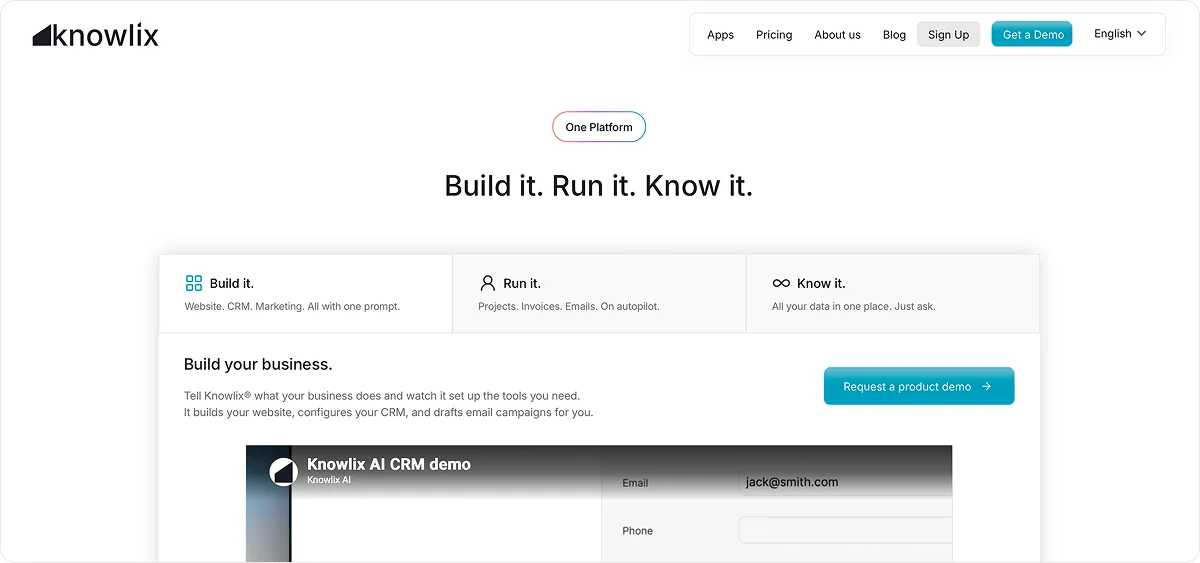
Knowlix is an all-in-one AI business platform that replaces disconnected software tools with a single workspace.
It replaces 50+ apps for project management, sales, marketing, and other business operations, all connected through an AI Teammate that centralizes data, conversations, and workflows.
Even with its extensive functionality, Knowlix remains easy to use, so teams can get started quickly without complicated setup processes or a steep learning curve.
For this reason, businesses can adopt AI smoothly and integrate it into everyday operations with minimal disruption.
Key features:
1. AI Teammate
Knowlix’s AI Teammate functions as a proactive assistant that works alongside teams to help coordinate and manage work more efficiently.
Instead of operating as a standalone chatbot, it unifies a range of AI capabilities, including chat assistants, phone agents, website builders, email support, customer service bots, sales assistants, and marketing tools, into an integrated system.
Microfab CEO Georg Pokorny uses the Knowlix AI Teammate to fix everyday ERP issues that previously required billable consultant calls, such as unlinked delivery notes that blocked invoice creation.
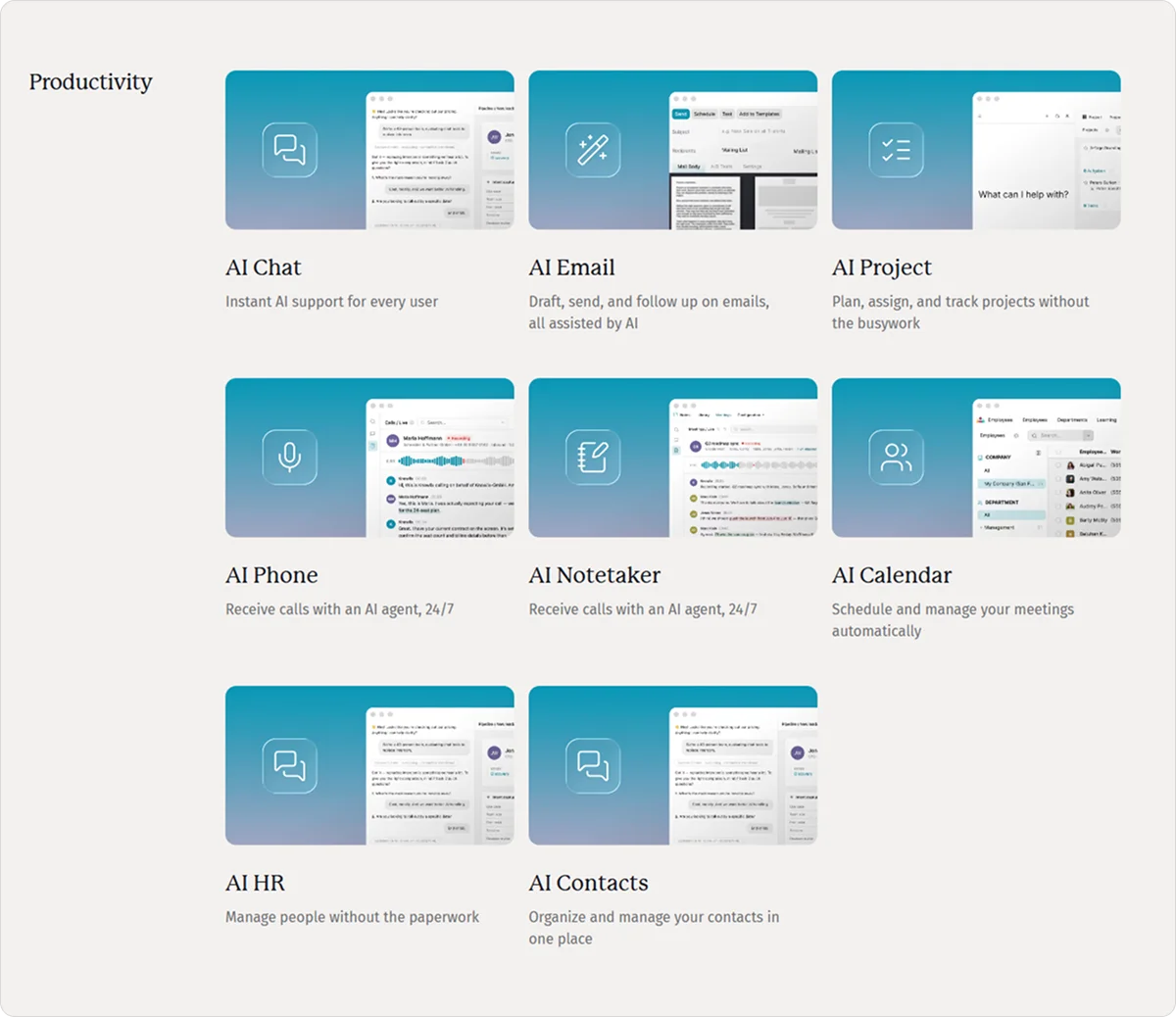
The unified approach reduces operational silos, minimizes manual coordination, and establishes a single source of truth for all project and business activity.
Because it is directly connected to company data, every action it takes is context-aware and automatically reflected across existing workflows. This ensures consistency across updates, conversations, and decisions.
The AI Teammate interprets context, intelligently updates tasks, and automatically executes next steps, such as adding new requests to project trackers, assigning follow-up tasks, updating deal or project stages after meetings, and keeping project timelines on track without manual input.
It maintains human oversight by requiring approval for critical actions to ensure you stay in control while still benefiting from automation.
2. Intelligent CRM
Knowlix includes a built-in intelligent CRM that helps you manage customer relationships by automating key sales and customer management processes.
It automatically captures incoming leads from customer interactions and organizes them into a visual sales pipeline.
The system also streamlines day-to-day activities such as call logging, note-taking, invoice generation, and meeting scheduling, all within a single unified platform.
AI-powered insights guide decision-making by recommending next steps, such as optimal follow-up timing or identifying customers at risk of churn, while also allowing you to assign tasks directly to the AI Teammate for continued execution.
All data remains fully connected across the system, with meeting notes and conversations syncing smoothly across CRM, calendar, support, and task management tools.
This way, teams always work with accurate, real-time information without manual coordination.
3. Customization capabilities
Knowlix allows you to fully customize your workspace by enabling or disabling over 50 integrated apps with a single click, which makes it easy to tailor the platform to your specific business needs.
As your organization grows or expands into new functions, the system scales and adapts alongside you, letting you activate only the tools you need at each stage of development.
This flexibility also applies to the AI Teammate, which adapts to your business context by learning your processes, terminology, and priorities.
As a result, it can execute tasks more accurately and support workflows to align with how your team actually works.
Pricing
Knowlix runs a 7-day free trial with 25+ apps and 10 AI credits, and it takes. It also offers two paid plans starting at $24.90 (€24.90) per user per month, including most apps and features, along with the AI Teammate.
2. Microsoft Dynamics 365 Business Central
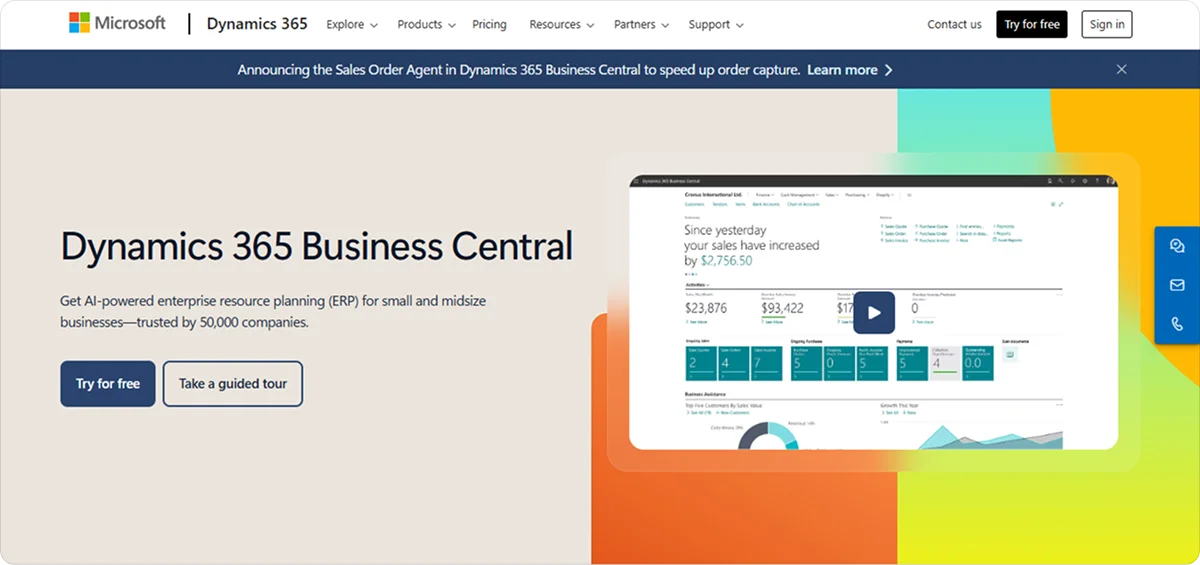
Microsoft Dynamics 365 Business Central is an ERP system that unifies CRM, finance, operations, inventory, sales, supply chain, and project management.
The main focus is on accounting, inventory, and production tools.
Key features:
- AI tools: Comprise AI agents that automate and handle ERP tasks, customer order requests, invoicing, and more
- Business intelligence: Includes built‑in dashboards, KPIs, real‑time reporting, export to Excel, and embedded Power BI workspaces
- Financial management: Supports general ledger management with automated entries, cash flow forecasting, budgeting tools, revenue and expense allocation, and more
- Project management capabilities: Helps businesses manage resource planning, track billable hours and expenses, and measure project profitability.
Pricing
Microsoft Dynamics 365 Business Central offers a 30-day free trial and two paid plans starting at $80 (€69) per user per month, paid annually.
3. Campfire

Campfire is an AI‑native ERP that focuses on automating GL, reconciliations, and revenue recognition.
Its solutions primarily cater to finance and accounting teams.
Key features:
- Core accounting: Provides a general ledger with a customizable chart of accounts, journal entries, AR/AP sub-ledgers, trial balances, and transaction management
- AI-powered automation: Categorizes transactions, automates reconciliations, matches payments to invoices, and detects anomalies
- Ember AI agent: Audits the close, explains variances, and proposes entries
- Financial reporting and analytics: Offers real-time dashboards, customizable reports, drill-down analytics, pivot tables, advanced filtering, and KPI tracking
Pricing
Campfire offers custom pricing based on your company size, transaction volume, and the specific accounting modules you need.
4. SAP Business One
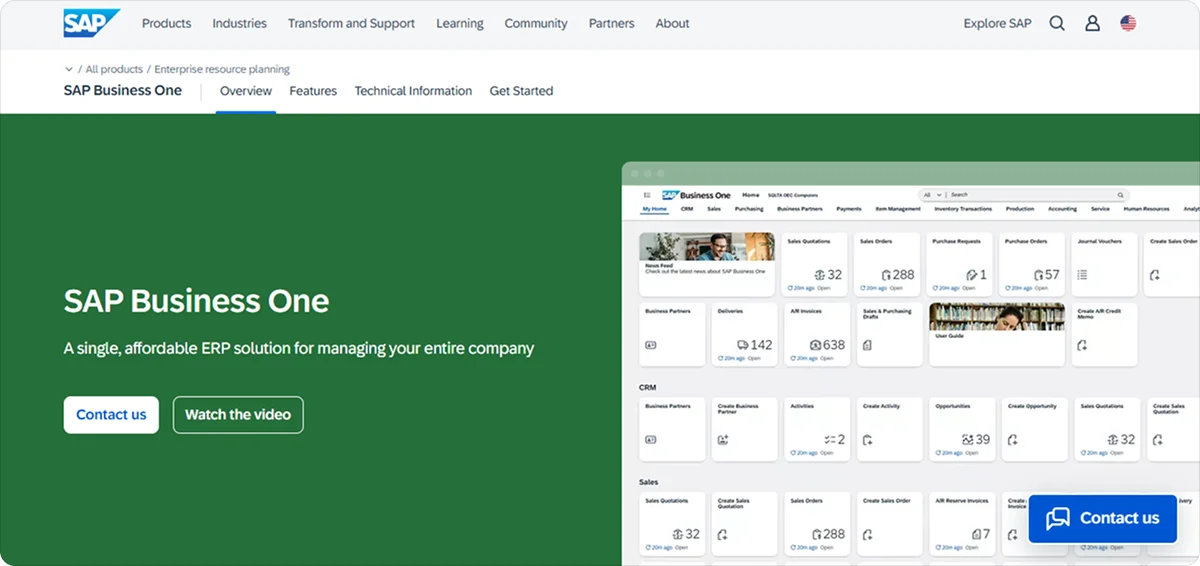
SAP Business One is an ERP system that combines finance, sales, purchasing, inventory, CRM, and reporting into one platform.
For companies with simple-to-moderate manufacturing or inventory needs, it can also handle production orders and planning.
Key features:
- Financial management: Automates accounting processes, cash flow tracking, budgeting, banking reconciliation, fixed asset management, and financial reporting
- Sales and customer management: Helps you manage the full customer lifecycle, including lead tracking, sales opportunities, marketing campaigns, customer data, service contracts, and mobile sales access
- Purchasing and inventory control: Streamlines procurement, purchase orders, warehouse management, accounts payable, inventory tracking, and more
- Business intelligence and analytics: Provides customizable dashboards, KPI tracking, interactive reporting, real-time analytics, and Microsoft Excel integration
Pricing
SAP Business One offers a quote‑based subscription model that depends on the number of users, business entities, and modules.
5. Epicor Kinetic
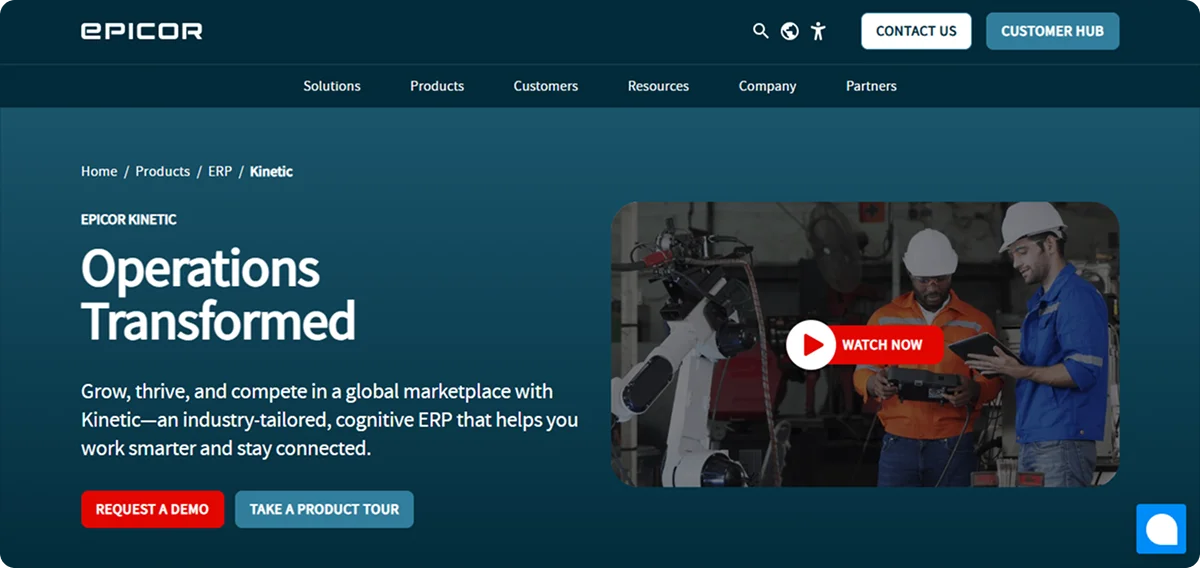
Epicor Kinetic is a global cloud ERP solution tailored to manufacturers with real-time business intelligence and built-in collaboration tools.
It provides solutions for finance, manufacturing, supply chain, CRM, and field service on a single platform.
Key features:
- Financial management: Supports accounting, budgeting, financial reporting, cost control, and global financial management with automation tools
- Business intelligence and analytics: Provides real-time dashboards, reporting tools, and advanced analytics
- Supply chain management: Improves visibility into procurement, sourcing, inventory, logistics, and supply chain operations
- Epicor Prism: Automatically sends RFQs to suppliers, parses and translates quotes, and recommends the best price
- Planning and scheduling: Includes advanced planning, forecasting, material requirements planning (MRP), and production scheduling tools for manufacturers
Pricing
Epicor Kinetic is subscription-based and depends on the number of users and modules you opt for.
6. Zoho One
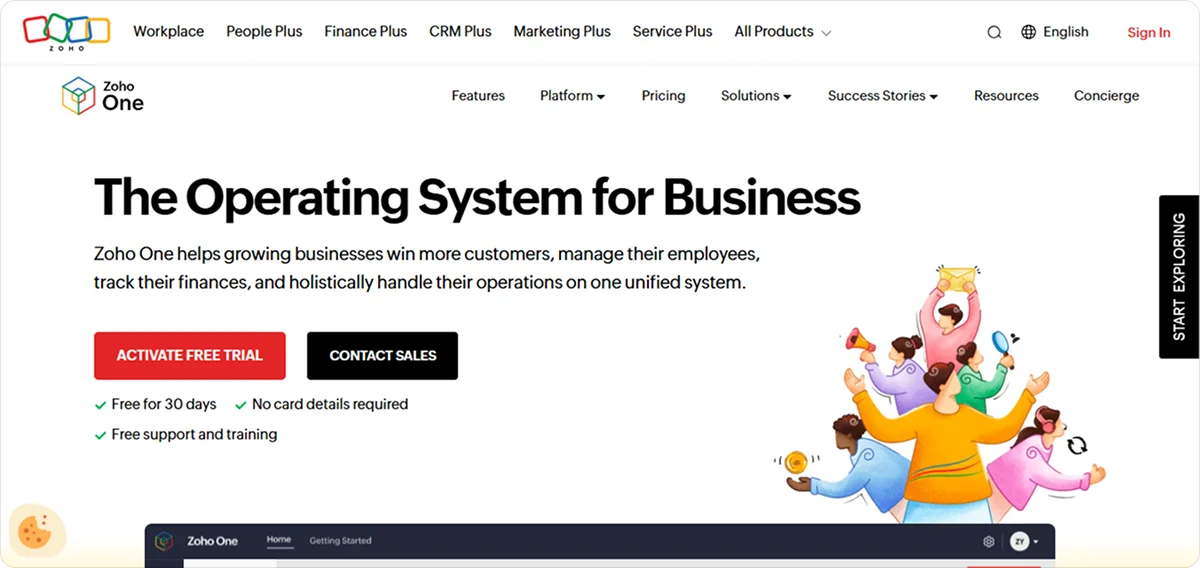
Zoho One is a cloud‑native ERP suite with 45+ integrated apps covering sales, marketing, service, finance, HR, operations, ecommerce, and more.
It also supports customization, app extension, integrations, and low-code app creation so you can adapt the solution to your workflows.
Key features:
- CRM capabilities: Centralizes customer information, conversations, activities, and follow-ups, and enables multichannel communication
- Pipeline management: Provides visual, drag-and-drop sales pipelines to track deals, monitor progress, and manage customer journeys
- Workflow automation: Automates repetitive tasks, reminders, notifications, and follow-up processes through workflow rules and automation tools
- Customization capabilities: Allows businesses to create multiple pipelines, customize fields, configure dashboards, and adapt workflows to different teams or departments
Pricing
Zoho One offers two pricing models: All Employee Pricing at $52 (€45) per employee per month and Flexible User Pricing at $122.08 (€105) per user per month.
What to look for in an ERP system
Small businesses benefit from solutions that prioritize simplicity and flexibility over raw power.
Key characteristics to look for include:
- Affordability: A strong ERP should have transparent pricing and deliver clear value without requiring a high upfront investment.
- Ease of use: The system should be intuitive so your team can adopt it quickly and effectively.
- Scalability: It should grow and adapt alongside your business, supporting everything from a small team to a much larger organization without major disruption.
- Integration capabilities: Since businesses rely on multiple tools, your ERP should connect smoothly with eCommerce platforms, payment systems, CRM tools, and other essential software.
An ERP choice outlives most software decisions, so it helps to know where the category is heading. Our piece on the future of ERP covers what changes first.
Why opt for Knowlix as your ERP system?
Knowlix, an all-in-one AI Business Platform, replaces 50+ apps, bringing everything together in a single workspace.
We combine full CRM capabilities for lead and sales management with tools for invoicing, project management, and operations, all enhanced by our AI Teammate.
With Knowlix, you can:
- Get your business up and running in a single day with no complex onboarding
- Eliminate multiple disconnected tools
- Cut down on unnecessary manual work
- Improve visibility across all business activities
- Automate key workflows for greater efficiency
Sign up for Knowlix to see how you can manage your entire business within an all-in-one AI Business Platform
How long does ERP setup take?
Setup time depends on the type of ERP. Cloud SMB platforms like Knowlix can be live in a single day, while traditional systems such as SAP Business One or Epicor Kinetic typically take several weeks to months for configuration, data migration, and training. Here’s how setup time compares by ERP type:
| ERP solution | Implementation time |
|---|---|
| Knowlix | 1 day (internal data) |
| Cloud SMB ERPs (Zoho One, Microsoft Dynamics 365 Business Central) | Zoho One: 6–8 weeks (standard implementation) Microsoft Dynamics 365 Business Central: 3–4 months for US small businesses (industry typical) |
| Enterprise ERPs (SAP Business One, Oracle NetSuite) | SAP Business One: 8–12 weeks Oracle NetSuite: 1–3 months for small businesses (industry typical) |


Frequently asked questions


Entry pricing ranges widely. Knowlix starts at $24.90 per user per month after a 7-day free trial, Microsoft Dynamics 365 Business Central starts at $80 per user per month, and Zoho One starts at $52 per employee per month. SAP Business One and Epicor Kinetic are quote-based, and total cost rises with implementation, data migration, and training.
ERP systems will focus more on smooth connectivity and ecosystem integration.
Businesses expect ERP platforms to easily link with other tools through APIs, along with flexible low-code and no-code options and prebuilt integrations that help automate and connect workflows across multiple systems.
The global ERP software market grew from $159.87 billion in 2025 to $175.94 billion in 2026, expanding at a 10.1% CAGR through 2030 to reach $258.59 billion.
Estimates vary by analyst methodology: Fortune Business Insights reports $92.6 billion for 2025 under a narrower market scope (cloud-only, software-only).
AI-native ERPs like Knowlix and Campfire were built with AI at the core rather than added on top of an older platform. They offer context-aware automation, natural-language queries, and proactive workflow execution. Traditional ERPs such as SAP Business One or Microsoft Dynamics 365 are adding AI agents, but their core architecture stays rule-based and module-oriented.
All-in-one platforms like Knowlix suit solopreneurs and small teams because they combine CRM, invoicing, and project management in one subscription. Zoho One also offers a broad app suite but costs more per user. Enterprise-oriented systems like SAP Business One or Epicor Kinetic are usually oversized for very small teams.
Subscribe for Our Newsletter
Book your call below.


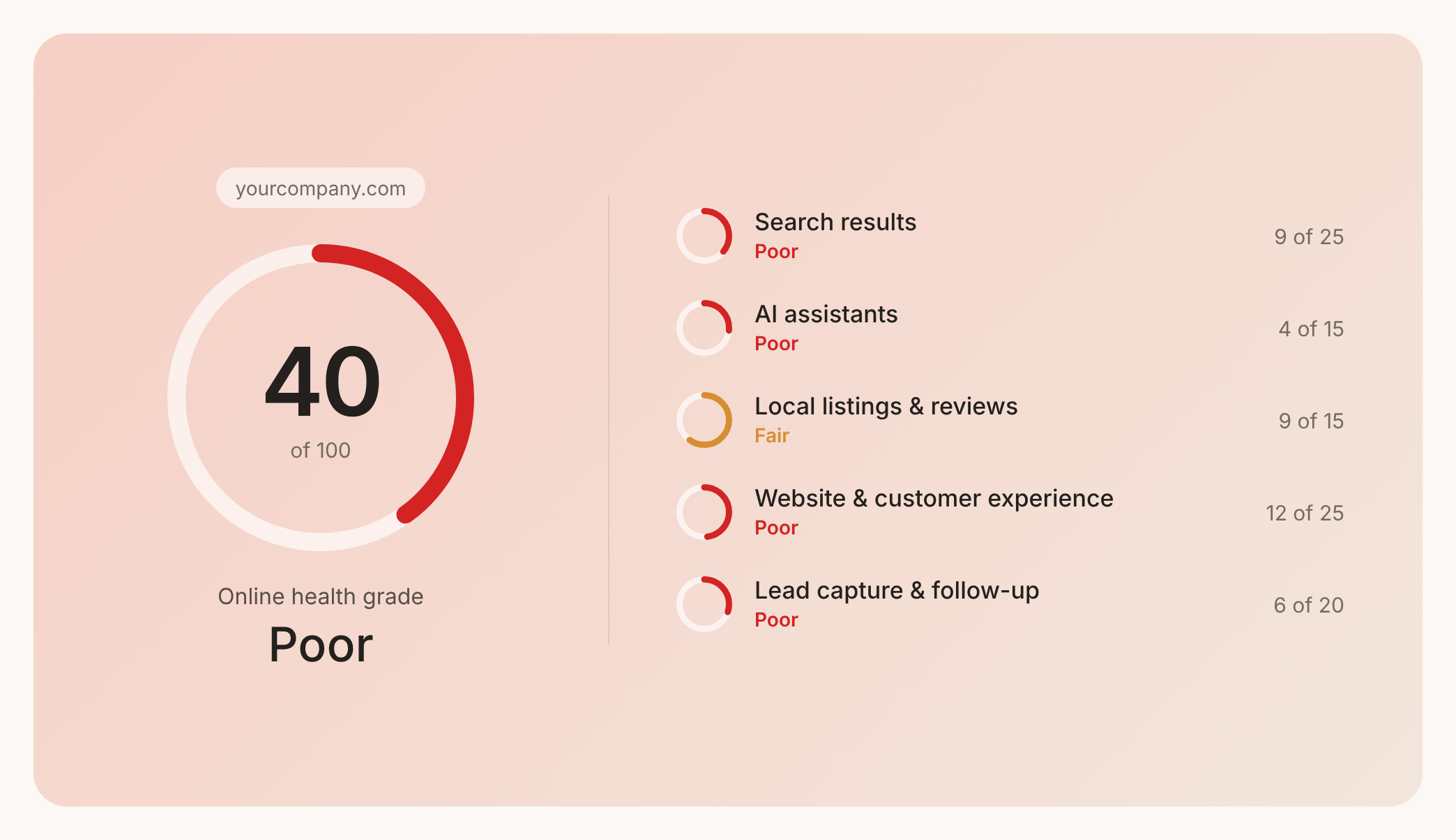

Check your website health score
Scan your site in seconds and make sure you're beating your competitors.
