
The Future of ERP: AI, Automation & What’s Next in 2026

Enterprise Resource Planning (ERP) is software that helps businesses manage and integrate their core operations, such as finance, sales, inventory, HR, and projects, into a single unified system.
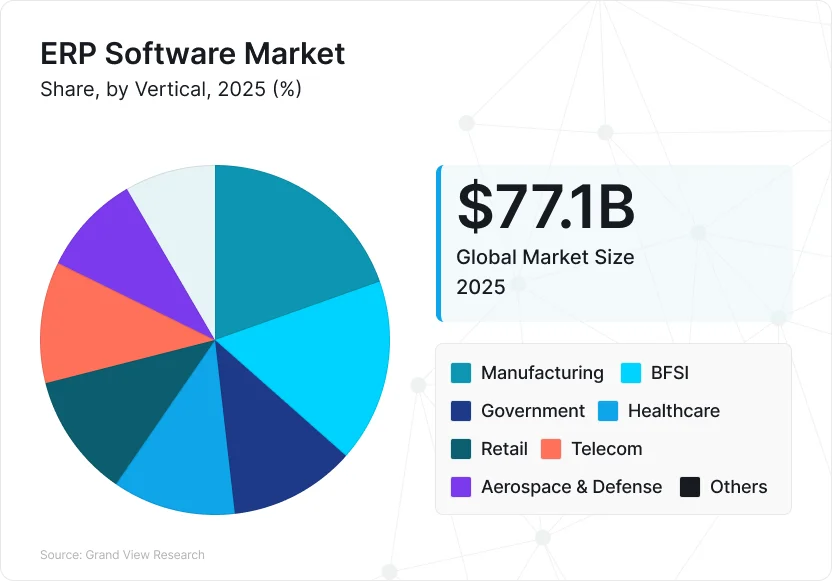
Strong demand for integrated process automation, cloud migration, and AI-driven analytics is pushing the ERP market from $77 billion in 2025 to a projected $157 billion by 2033, at a CAGR of 9.5%.
This signals a major transition in how businesses operate, especially in manufacturing, services, and public-sector organizations.
Read on to learn more about the future of ERP, with a focus on AI and automation, and the impact it will have on small businesses.
Key takeaways
- ERP moves toward cloud, intelligence, and accessibility for smaller businesses
Cloud systems lead due to lower costs and flexibility, while growing mid-sized adoption is making ERP more accessible for small businesses. - AI is transforming ERP from a data system into a decision-making platform
ERP systems now predict outcomes, detect risks, and recommend actions in real time, which enables faster and smarter decisions. - Automation is creating major efficiency gains for small businesses
By reducing manual work, ERP automation helps small teams do more with fewer resources, improving speed, accuracy, and scalability. - The future of ERP is moving toward autonomy and modular flexibility
Trends such as composable systems, AI-driven workflows, and real-time analytics are making ERP more adaptable and tailored to business needs, with AI agents handling end-to-end workflows. - Knowlix brings these trends together in one AI-driven ERP platform
Knowlix unifies CRM, ERP, and AI agents into one system that automates workflows, centralizes operations, and enables natural-language control, which gives small businesses enterprise-level capabilities without the usual complexity or cost.
What does current market data show about ERP—and what does it mean for small businesses?
Flexibility and intelligence are the two major factors impacting the ERP market. Cloud-based systems dominate, having accounted for 54.4% of the market in 2025, as businesses prioritize scalability and lower costs.
Across functions, finance is leading adoption and growth with 25.99% market share, driven by rising cybersecurity demands and the need for real-time financial visibility. HR is also expanding quickly as companies invest in tools to support remote and hybrid workforces.
By vertical, the manufacturing industry accounted for 19.75% of the market in 2025.
One of the most important signals for small businesses is the rise of mid-sized companies, which held the largest share at 37.56% in 2025 and are expected to grow the fastest.
Mid-sized companies connect enterprise technology with small-business adoption.
As mid-sized businesses invest in ERP, they push vendors to create more affordable, flexible, and modular solutions, which makes advanced capabilities more accessible to smaller teams.
The role of AI in ERP
The AI-in-ERP market is expected to grow at an impressive 27.3% CAGR between 2025 and 2029, which highlights how central AI has become to ERPs.
Unlike traditional ERP systems that relied on rigid, rule-based processes, AI-powered ERP platforms can analyze patterns, learn from historical data, make predictions, and suggest the next steps in real time.
As a result, ERPs are changing from reactive to proactive systems, and from manual workflows to autonomous operations.
Key AI capabilities in ERP systems
AI has introduced capabilities that were once available only through separate tools or large analytics teams.
Some of the most impactful include:
- Predictive analytics: ERP systems can forecast demand, revenue, and cash flow with much greater accuracy, helping businesses plan ahead.
- AI copilots and intelligent agents: Built-in assistants can automate workflows, spot anomalies, recommend actions, and guide users through complex processes in real time.
- Anomaly detection and risk alerts: AI can instantly spot unusual patterns, such as unexpected spending spikes or inventory inconsistencies, before they become bigger problems.
- Natural language interfaces: Users can interact with ERP systems through simple, conversational queries, which makes systems far more accessible to non-technical users.
Did you know?
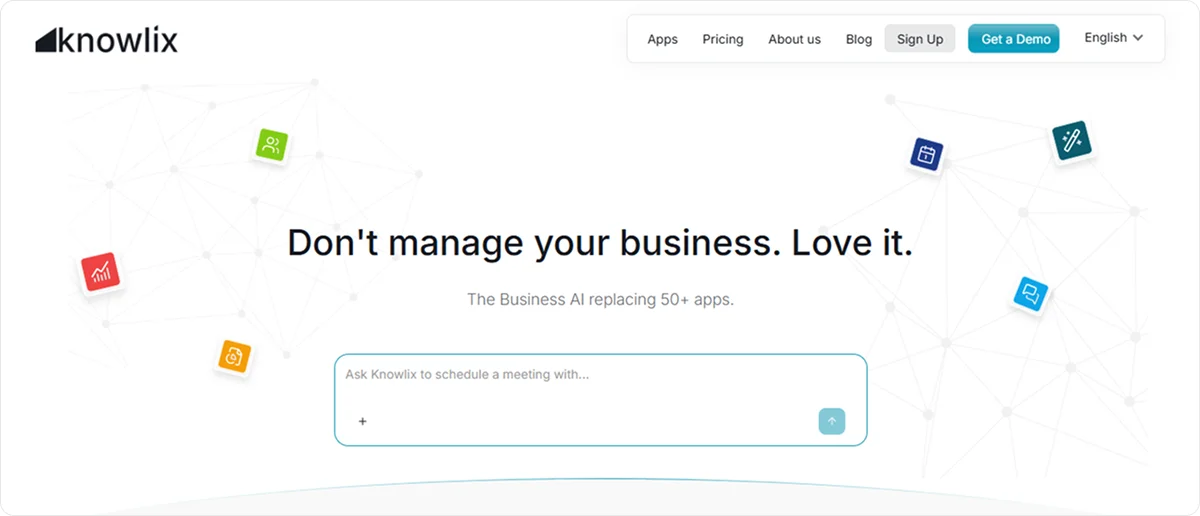
With Knowlix AI Chat, you provide a prompt in plain language, and the AI handles the rest by extracting key details, detecting duplicates, and automatically turning everything into structured records.
The impact of AI in ERP for small businesses
One of the biggest pain points in traditional ERP systems has been manual work, especially data entry and repetitive administrative tasks.
AI directly addresses this by automating large portions of day-to-day operations, which reduces both errors and time spent on low-value work.
Perhaps even more importantly, AI allows small teams to operate at a much higher level. Tasks that once required multiple roles, such as analysts, accountants, and operations managers, can now be supported by a single system.
As a result, small businesses can move faster and make better decisions.
The role of automation in ERP
Automation is the capability of ERP systems and AI to handle repetitive business processes automatically, with minimal human input.
It connects departments and ensures data flows smoothly across the organization.
The role of automation in ERP depends on the sector or department, and can include:
- Finance (invoicing, reconciliation, reporting): ERP systems can automatically generate invoices, match payments, reconcile accounts, and prepare financial reports.
- Inventory and supply chain management: Automation helps track stock levels, trigger reorders, optimize inventory distribution, and predict supply chain disruptions.
- HR and payroll: ERP systems streamline HR operations while reducing administrative burden by handling onboarding, attendance tracking, payroll processing, compliance, and more.
- Order processing and customer workflows: Automation can process, validate, and route orders, which improves speed and reduces errors in customer-facing operations.
In addition to being automated, these processes are becoming more connected and intelligent, enabling end-to-end workflow optimization.
The impact of automation on small businesses
Automation delivers value across all business sizes, but for SMBs, the impact may be more obvious because it enables them to operate with the speed, efficiency, and consistency of much larger organizations.
Here are the key benefits:
- Limited staff, greater leverage: Small teams often juggle multiple roles. Automation allows them to handle higher workloads without burnout and multiply their capacity.
- Faster processing times: AI-driven ERP systems can reduce processing time by up to 40% in certain workflows, particularly in finance and operations. This results in quicker turnaround times and more responsive business operations.
- Higher ROI from every improvement: SMBs operate with tighter margins, which means that saving time or reducing errors has a more immediate and noticeable financial impact.
- Reduced reliance on external support: Automated ERP systems minimize the need for consultants, manual oversight, or complex customizations.
- Ability to scale without growing headcount: As the business grows, automated processes can handle increased demand without requiring immediate hiring.
The future of ERP: What’s next?
The future of ERP is less about complex systems and more about flexible, intelligent platforms that adapt and scale in real time.
Here are the major trends for 2026.
| Trend | What it is | Why it’s important |
|---|---|---|
| Composable ERP | Modular ERP built from selectable components | Reduces cost, reduces complexity, and enables scalability |
| Autonomous processes & agentic AI | AI agents that execute end-to-end workflows | Eliminates manual work, accelerates decisions, and improves efficiency |
| Real-time analytics & risk forecasting | Live dashboards with predictive scenario modeling | Improves visibility, enables foresight, and supports faster action |
| Industry-specific ERP | ERP tailored to specific industry needs | Increases relevance, improves accuracy, and speeds up implementation |
| Low-code/no-code ERP | Visual, AI-assisted system customization | Removes technical barriers, speeds up development, and empowers users |
1. Composable ERP
Composable ERP is a system where businesses can build their ERP environment using modular components that fit their exact needs.
This approach allows companies to:
- Choose only the features they actually use to streamline and automate finance, inventory, or HR
- Integrate best-in-class tools instead of relying on separate tools across different platforms
- Scale systems gradually as the business grows
When you run a small business, this modularity is invaluable because it reduces both cost and complexity. Instead of paying for a full enterprise suite, you can start small and expand over time without rebuilding your entire system.
In addition, composable ERPs let your setup grow and change with your business, so it’s easier to adapt as business models develop or new tools enter the market.
Worth knowing:
Knowlix lets you enable or disable over 50 apps with a single click, so the platform instantly adapts to your needs.
This way, teams can start with the features they need at the time and add more functionality as they grow.
2. Autonomous business processes and agentic AI
Autonomous business processes are end-to-end workflows supported by AI agents that actively execute and manage them with minimal human involvement.
Adding these processes to ERP systems would allow them to make and execute decisions within defined boundaries, with multiple AI agents working together as a coordinated digital workforce.
This way, decisions and actions are coordinated automatically across multiple steps.
These systems can handle:
- Procurement decisions, by selecting suppliers based on price, reliability, and demand forecasts
- Financial forecasting, by analyzing trends and adjusting projections in real time
- Workflow optimization, by reallocating resources or adjusting operations automatically based on performance data
These systems often rely on multi-agent collaboration, where different AI agents specialize in different functions. So, one can handle procurement, another might manage finance approvals, and others can coordinate logistics or compliance.
Worth knowing:
Knowlix’s AI Teammate is a system of integrated AI agents that work alongside your team. It replaces multiple standalone tools, including chat assistants, phone agents, website builders, email platforms, support bots, sales assistants, and marketing tools.
Because these agents operate directly within your system, every action is automatically connected to your existing data to ensure consistency and accuracy across workflows.
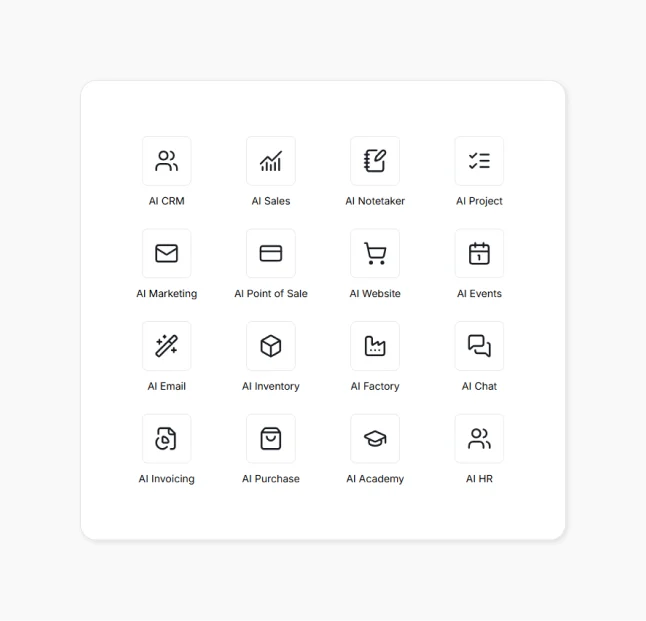
The AI Teammate understands context, keeps records continuously updated, and suggests relevant next steps based on ongoing activity.
For example, after a meeting, it can automatically:
- Summarize key points
- Create or update contacts
- Update lead and deal information
- Draft follow-up emails
- Generate quotes
- Add tasks to project trackers
- Move deals to the appropriate stage
All updates remain visible to the relevant team members, while execution stays fully controlled, as the system requires approval before finalizing actions.
As a result, business processes can move forward efficiently without sacrificing oversight or control.
3. Deeper real-time analytics and risk forecasting
Real-time dashboards will become more personalized to show different insights based on the user’s role, priorities, and decision-making needs.
They will continuously update views of business performance by analyzing information closer to where it is generated: in warehouses, production lines, or delivery systems.
As a result, you can gain near-instant visibility into operational changes such as inventory movement, demand fluctuations, or logistics delays.
In addition, risk forecasting will become more advanced and proactive. It already analyzes large-scale patterns across economic, industry, and operational data to identify potential issues.
What’s new is that, instead of simply alerting businesses to problems, it will support scenario-based planning, which allows you to explore different “what-if” situations and understand their potential impact on cash flow, inventory, and operations.
4. Industry-specific ERP
Industry-specific ERP solutions are designed to meet the unique needs of different sectors, and they will gain increasing traction.
The Panorama report shows a significant impact of niche ERP systems, with 95% of organizations reporting better customer experiences and 91% reporting both improved process standardization and reduced IT maintenance costs.
Instead of generic tools, ERP platforms will become more specialized for industries such as:
- Retail and eCommerce
- Manufacturing and supply chain-heavy businesses
- Healthcare and regulated industries
- Professional services
For small businesses, this shortens implementation time, and it improves accuracy and usability, since the system is already designed around their specific business logic.
5. AI-powered low-code/no-code ERP
These types of ERP platforms enable you to build, customize, and automate business processes using simple visual interfaces, natural-language instructions, and configurations instead of traditional programming.
As a result, it makes system customization much more accessible to non-technical users.
Instead of writing complex code, you can describe what you need in natural language, and the system can translate that into functional workflows.
AI then supports the process by:
- Suggesting logical workflow structures
- Generating underlying code automatically where necessary
- Recommending integrations with other business systems
- Checking for errors or inefficiencies in real time
For example, you might describe a need to optimize supplier selection based on pricing trends and historical performance.
The system can then help generate a complete workflow that includes data inputs, decision rules, and predictive analytics components to support the process.
This way, ERP systems become adaptable platforms that deliver enterprise-level capability without enterprise-level complexity.
How can Knowlix help you get ERP future-ready?
Knowlix is an all-in-one agentic ERP platform that combines full CRM functionality for lead and sales management with ERP capabilities, including invoicing, project management, and operational workflows.
All capabilities are supported by an AI Teammate, which provides access to over 50 integrated business tools to automate and streamline everyday tasks.
Connected to all the business apps you use to run your business, the AI Teammate has full context of your operations and proactively suggests next steps based on decisions made in meetings or changes across your tools.
Here’s what Knowlix offers:
- Unified CRM and ERP functionality into a single system for managing customers, sales, finance, projects, and operations
- AI agents to automate and support end-to-end business workflows, reducing manual coordination across teams
- Natural language-based record creation and updating, which turns unstructured information into structured data instantly
- Replacement of multiple standalone business tools by embedding communication, sales, support, and operational capabilities into one platform
- Real-time visibility and controlled automation across processes to ensure teams stay aligned
Sign up for Knowlix to see how you can get big-business power on small budgets.


Frequently asked questions


Interoperability and ecosystem integration are core expectations for ERP systems. ERPs should offer strong API frameworks, low-code and no-code customization options, and ready-made integrations.
They help businesses automate repetitive tasks, generate real-time insights, and predict future outcomes, such as demand shifts or financial risks.
This reduces manual work and allows teams to focus more on strategy and growth instead of day-to-day operations.
AI won’t replace ERP. Instead, it will work alongside it to create a more intelligent, reliable, and action-oriented platform.
By layering AI capabilities and advanced reasoning on top of a solid ERP foundation, you can move from managing data to actively generating insights and executing decisions more effectively.
Subscribe for Our Newsletter
Book your call below.


Check your website health score
Scan your site in seconds and make sure you're beating your competitors.
