
AI Employee for Small Business: What Works in 2026

An AI employee is software that executes defined digital tasks on its own, from drafting invoices to updating records. The category is real in 2026 but young. Independent tests show the best agents still finish only a fraction of open-ended office work, and Gartner expects over 40% of agentic AI projects to be canceled by end-2027. It works today for narrow, high-volume, structured tasks with clear success criteria. Priced against hiring it looks cheap, though it is not a like-for-like swap. The buyer's job is to tell an agent that executes from a chatbot that only drafts.
Disclosure: Knowlix builds one of the product categories described below (an AI that executes work inside the apps it ships with), so read our section as the interested party it is. Every price and statistic carries a source with its retrieval date, the same criteria apply to every category, and the real limits of our own product are stated. All vendor data comes from public pages, last verified 2026-07-10.
Last updated: 2026-07-10
An AI employee is a software agent that executes defined digital tasks on its own, reading a request, planning the steps, and carrying them out across tools until the job is done. The category in 2026 is real and still young. As of late 2025, 88% of organizations used AI in at least one business function, up from 78% a year earlier (McKinsey, The State of AI: Global Survey 2025). Marketing has raced ahead of what these agents reliably finish, so the useful question for a small business is narrower: what actually works today, what does it cost against a hire, and how do you tell a real agent from a chatbot wearing a name tag. This guide answers each in turn, with independent evidence rather than vendor promises.
What is an AI employee?
An AI employee is software that takes on a defined work responsibility and executes the steps itself instead of only answering questions. That framing separates it from two nearby things. A chat assistant responds when a person prompts it and then waits. An automation tool follows a fixed if-this-then-that rule with no judgment. An AI employee sits between them: it reasons about a goal, plans a sequence, and acts across tools to reach it (Kuse, AI Employees: The New Workforce Revolution).
The category has a definitional split worth knowing before you shop. Some vendors define one as a worker that replaces a task. Others define it as a copilot that helps your staff finish theirs. Salesforce, per its small-business blog, describes an employee agent as AI that operates inside your existing business software to help employees complete tasks, which is the copilot reading (Salesforce, 8 Ways Employee Agents Are Helping Small Businesses, small-business blog, indexed summary). The same two words point at two different products, so pin down which one a vendor means before you compare prices.
What can an AI employee actually do in 2026?
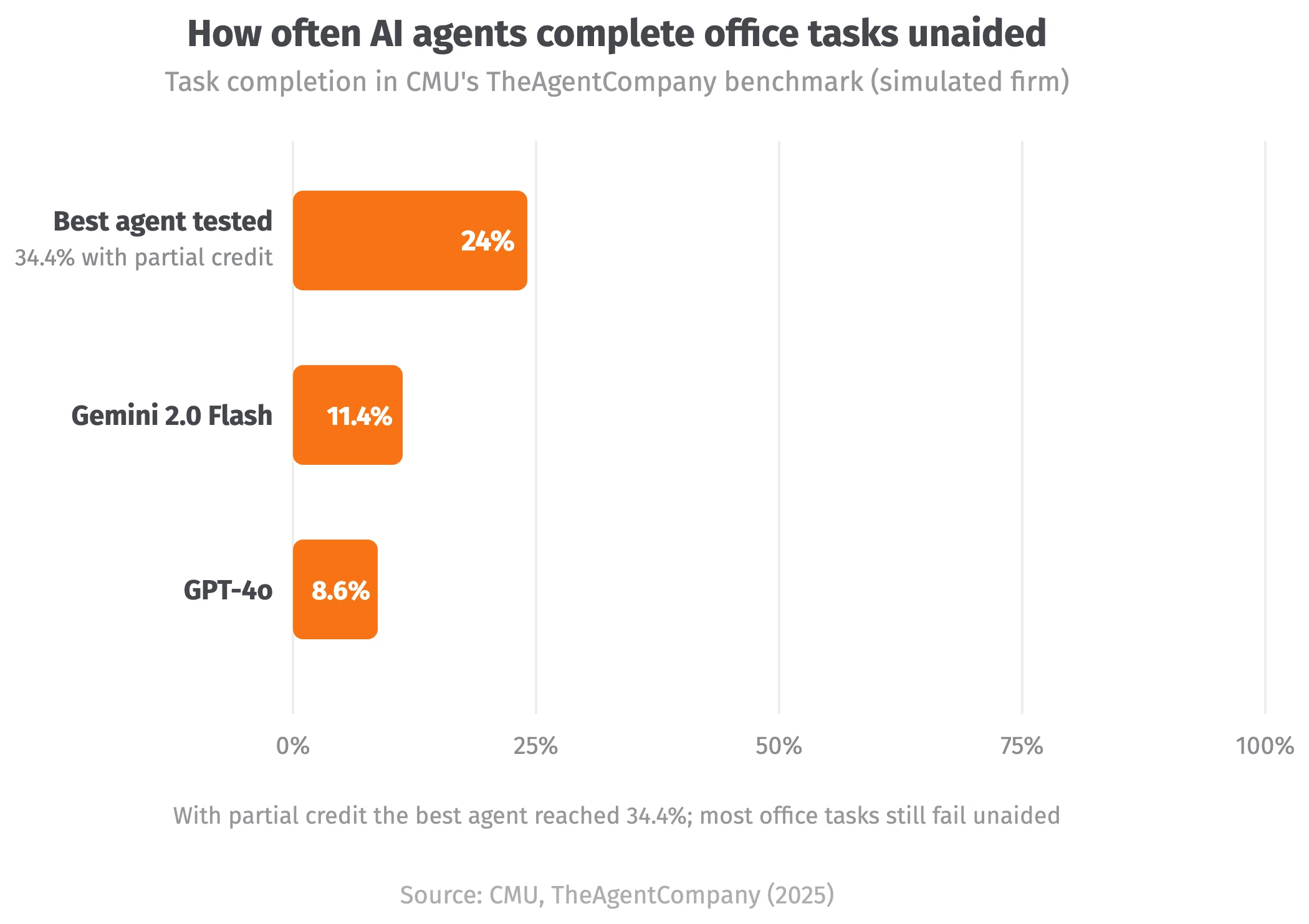
The honest answer: narrow, well-defined, high-volume tasks work, and open-ended judgment work does not yet. In Carnegie Mellon's TheAgentCompany benchmark, a simulated 16-person software firm where agents browsed the web, used spreadsheets, wrote code, and messaged colleagues, the best agent completed only 24% of tasks (34.4% with partial credit), with weaker models far below that (Carnegie Mellon University School of Computer Science, TheAgentCompany). The failures were mundane: one agent could not dismiss a pop-up, another failed to contact HR when told to, and a third, unable to find the right contact, renamed another user to stand in for them.
What reliably works today is the opposite of open-ended. These agents handle drafting and sending templated communications, data entry and record updates, categorizing transactions, scheduling, first-pass research, and chasing overdue invoices, provided the task has clear success criteria and the AI has structured access to the systems it works in. What still needs a person is open-ended work across unfamiliar screens, judgment calls and exceptions, relationships, and anything unsupervised where an error is expensive. Even category vendors concede the line: Lindy's own explainer lists relationship-building, strategy, ambiguous decisions, creative work, management, and emotional intelligence among the things an AI employee cannot replace (Lindy, What is an AI employee?).
The hype gap matters when you buy. Gartner expects over 40% of agentic AI projects to be canceled by the end of 2027, citing cost, unclear value, and weak risk controls, and warns of rampant "agent washing," estimating only about 130 of thousands of self-described agentic vendors are genuine (Gartner, Gartner Predicts Over 40% of Agentic AI Projects Will Be Canceled by End of 2027). Read the capability claims with that ratio in mind. A demo shows the 24%; the marketing sells the 100%.
For the task-by-task version of that boundary, our breakdown of AI that automates admin work goes through the eight workflows one at a time.
What are the types of AI employees?
| Type | What it is | Named examples | Entry price | What lands back on you |
|---|---|---|---|---|
| Persona bundles | Named "helpers" that are specialized chat assistants plus templates | Sintra, Marblism | $15.60–48.50/mo (Sintra); $24–44/mo (Marblism) | Output is drafts and suggestions; a person still executes in the real systems |
| Agent builders | Platforms where the AI executes multi-step tasks you design | Lindy | $49.99–199.99/mo | You build, test, and maintain the workflows yourself |
| Single-role agents | One job done end to end | Artisan, 11x | $250–600/mo (Artisan); pricing not published (11x) | Scope is one function only; everything else stays manual |
| AI embedded in the apps | AI that executes inside the business apps it ships with | Knowlix | $24.90 (€24.90)/user/mo | Least; the AI operates the CRM, invoicing, and projects directly |
| AI-assisted productivity suites | AI-assisted productivity tools marketed with worker language | Motion | $19–29/seat/mo | Planning and writing help; execution stays with you |
Types of "AI employee" products, with named examples and entry pricing (verified on vendor pages 2026-07-10; prices as sourced in USD, not converted)
Five kinds of product get sold as an "AI employee," and they behave very differently. The cheapest ones draft and suggest; the pricier ones execute one narrow job end to end. Knowing which bucket a tool sits in tells you more than its price does, because it predicts how much work still lands back on your desk. The table below groups the category with named examples and current pricing, all verified on vendor pages for July 2026 unless marked.
A few notes on the examples. Persona bundles like Sintra and Marblism wrap chat assistants in named characters; Marblism markets its six "employees" as replacing $2K–$10K/mo in services for roughly $24–44/mo, a vendor claim with no published methodology (Marblism, Pricing). Agent builders like Lindy come closest to real end-to-end execution, at the cost of making you the maintainer (Lindy, Pricing). Single-role agents do exactly one job: Artisan sells "Ava," an AI sales rep for outbound, on a tier literally named "Employee" at $600/mo (Artisan, Pricing), and 11x sells digital workers for revenue teams with no public pricing (11x). If your question is which tool for sales pipeline specifically, that intent starts our best AI sales assistant guide instead. Motion sits in the last bucket: a capable AI work suite marketed with "137% more work" language, useful mostly as a reminder that "AI employee" is a marketing term as often as a product one (Motion, Pricing).
OpenAI’s entry into this category is worth reading separately. Our explainer on ChatGPT Work covers where it fits.
What does an AI employee cost compared to hiring?
| Option | Rough monthly cost | What you get | Source |
|---|---|---|---|
| Full-time admin hire (loaded) | ~$5,500/mo (~$66k/yr) | A person who handles open-ended, judgment-heavy work | BLS OOH (2024) + ECEC (2026) |
| US virtual assistant, part-time | ~$2,200/mo (20 hrs/wk at ~$25.75/hr) | A person for delegated tasks, hourly | Indeed Salaries (2026) |
| AI employee tools | $15.60–600/mo | Software that executes narrow, defined tasks | Vendor pages (2026-07-10) |
| Knowlix AI Teammate | $24.90 (€24.90)/user/mo | AI that runs back-office work inside its apps | knowlix.ai/pricing (2026-07-10) |
Monthly cost, an AI employee against the alternatives (US figures; sources dated 2026-07-10; not a like-for-like comparison, see below)
On paper the software costs a fraction of a hire, though the two are not doing the same job. A full-time administrative employee earns a median $46,320 a year in the US (U.S. Bureau of Labor Statistics, Office and Administrative Support Occupations). Salary understates the real bill, because benefits add roughly 30%: across private industry, wages are 69.9% of compensation and benefits 30.1%, which pushes that salary to about $66,000 fully loaded (U.S. Bureau of Labor Statistics, Employer Costs for Employee Compensation, Q1 2026). AI-employee tools, by contrast, run from about $15.60/mo to $600/mo depending on the type above.

One caveat sits under those numbers. None of these tools is a like-for-like replacement for a hire, because it completes a fraction of the open-ended tasks a person handles, as the 24% benchmark above shows. The fair comparison is task-level: measure the cost of the specific routine work you would hand it, then price that against a tool. Where the math turns compelling is the hiring squeeze. In June 2026, 32% of small business owners reported job openings they could not fill, and 51% reported few or no qualified applicants (NFIB, Monthly Jobs Report). When the seat sits empty anyway, software that clears the routine backlog earns its keep. The virtual-assistant row above is a single point of reference; if replacing a VA is your actual question, that is its own decision with its own trade-offs.
How do you avoid getting agent-washed?
Agent washing is real and common: Gartner estimates only about 130 of thousands of self-described agentic vendors are genuine (Gartner, 2025, cited above). A rebranded chatbot with a human name is easy to sell and hard to spot in a demo. Five buyer tests cut through it fast.
- Does it execute or does it draft? Ask the vendor to show the task finishing inside your actual systems, not a polished draft that a person then copies and pastes. Drafting is a chatbot; finishing is an agent.
- Who maintains it? Some tools hand you a builder and expect you to design and test the workflows. Confirm whether you are buying a worker or a construction kit, because the second one adds a job rather than removing one.
- What happens when it breaks? Every agent fails on some tasks. Ask what the tool does on failure: does it stop, flag a person, and leave a clear trail, or does it guess and keep going? Treat a safe failure mode as a buying criterion.
- Is the pricing usage-metered? A flat seat and a metered seat are two different budgets. Ask whether heavy use triggers overages, and who carries that risk once real volume arrives.
- Can you audit what it did? You need a record of every action the agent took to trust it with anything that touches money or customers. If it cannot show its work, treat it as a demo.
Run those five against any tool that calls itself an AI employee. The ones that answer cleanly are the ones worth a trial.
Where does an AI Teammate fit in?
An AI Teammate is the embedded-in-your-apps type from the table above: AI that executes inside the business apps it ships with instead of answering about a stack it sits on top of. Our read of the benchmark data supports that design: the CMU failures were navigation failures across third-party tools, and structured access to the system of record removes that failure class. The benchmark itself tested agents on external tools only, so treat this as reasoning, and weigh this section accordingly — it is where our own product sits.
Knowlix is an all-in-one AI Business Platform for small businesses. Per the product page, its AI Teammate runs back-office work inside the apps it bundles, drafting and sending invoices, chasing the unpaid ones, and updating records after conversations, across CRM, invoicing, and projects (knowlix.ai). Pricing is a flat $24.90 (€24.90)/user/mo (reduced from $35.60), with a 7-day trial (knowlix.ai/pricing). The honest limits: it is a young product with a small third-party review footprint, and it is the wrong pick if you need a governed multi-model chat workspace for a thousand-plus employees.
If you want to see the execute-the-work approach in one narrow task first, the invoice-chasing walkthrough shows what "the AI does it" looks like end to end, and the platform overview for small business covers the wider setup. For a broader comparison of per-seat chat workspaces, see our Langdock alternatives rundown. You can start the 7-day trial at knowlix.ai with no card.


Frequently asked questions


An AI employee is software that executes a defined digital task on its own, reading a request, planning the steps, and carrying them out across tools until the job is done. It goes further than a chatbot that only answers questions.
AI employee tools run from about $15.60 to $600 a month in 2026, depending on the type. That is a fraction of a full-time US admin hire, which costs roughly $66,000 a year once benefits are loaded in (BLS, 2024–2026).
Not fully in 2026. Carnegie Mellon's TheAgentCompany benchmark found the best agent completed only 24% of office tasks (CMU, 2025). It handles narrow, high-volume, defined work well, while judgment, relationships, and open-ended tasks still need a person.
A chatbot answers questions when you prompt it and then waits. An AI employee executes the task itself, drafting and sending the invoice, updating the record, moving the job forward, rather than just describing how.
Pick one narrow, repetitive task with clear success criteria, such as invoice chasing or record updates. Trial a tool that executes that task inside your systems, confirm it leaves an audit trail, then expand from there.
Subscribe for Our Newsletter
Book your call below.


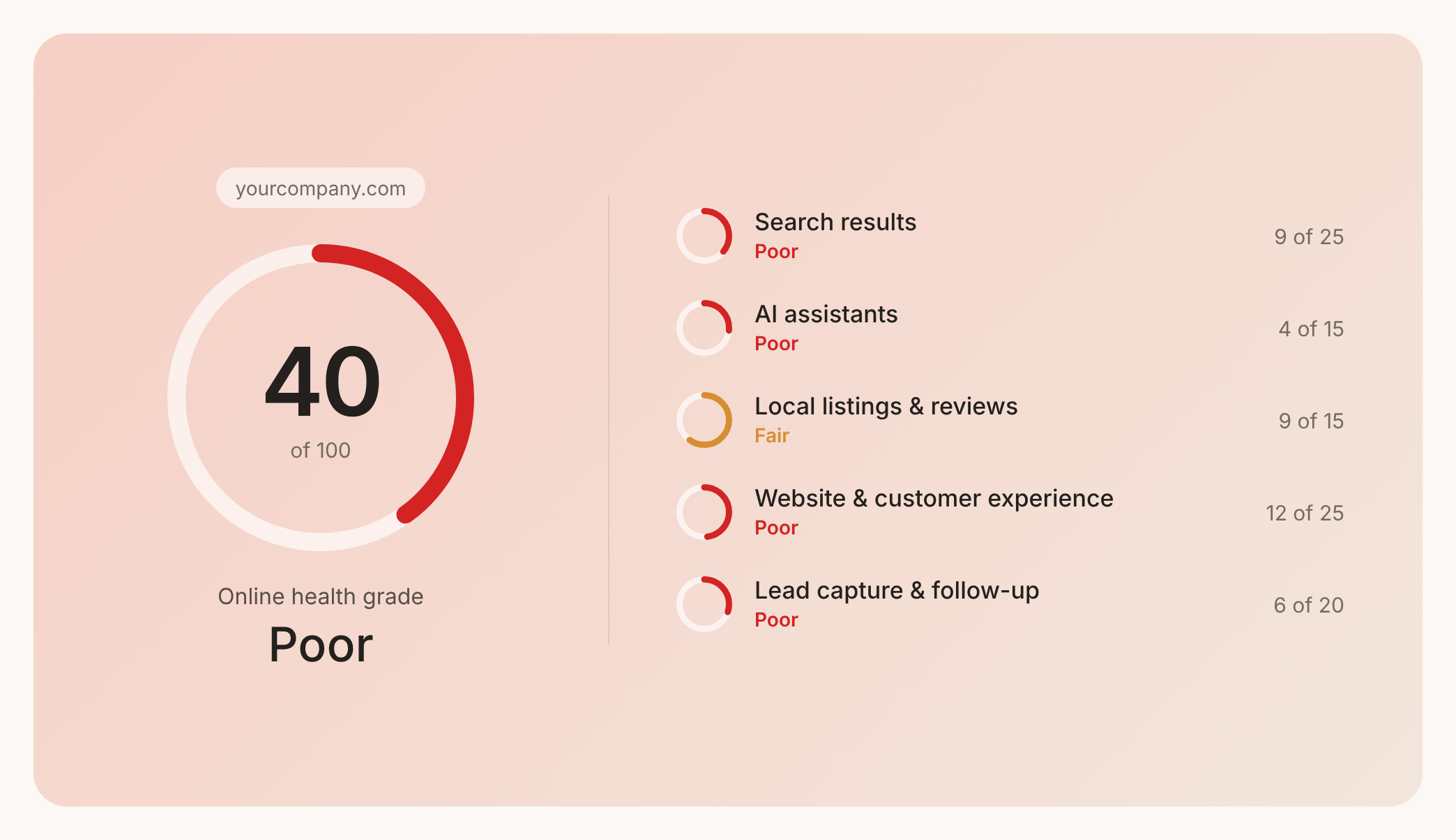

Check your website health score
Scan your site in seconds and make sure you're beating your competitors.
